AI Is Quietly Eliminating Entry-Level Management Jobs — Half of India’s MBA Grads Are Unprepared (And What You Should Do About It)


Let us start with a number that should make every management student pause.
The employability rate for MBA graduates in India dropped to 72.76% in 2026, down from 78% in 2025 — with the India Skills Report 2026 noting that this signals an “industry shift towards applied, cross-domain managerial expertise.”
That is not a minor statistical dip. That is a warning signal from the market. And it is happening at the exact moment that artificial intelligence is moving into the very roles that management graduates used to walk into straight out of college.
This is the conversation nobody is having loudly enough in India’s management education circles. So let us have it here — plainly, honestly, and with a path forward.
What Is Actually Happening to Entry-Level Management Jobs
When people say “AI is taking jobs,” the instinct is to either panic or dismiss it as hype. Neither response is useful. What is useful is understanding precisely which jobs are being reshaped and why.
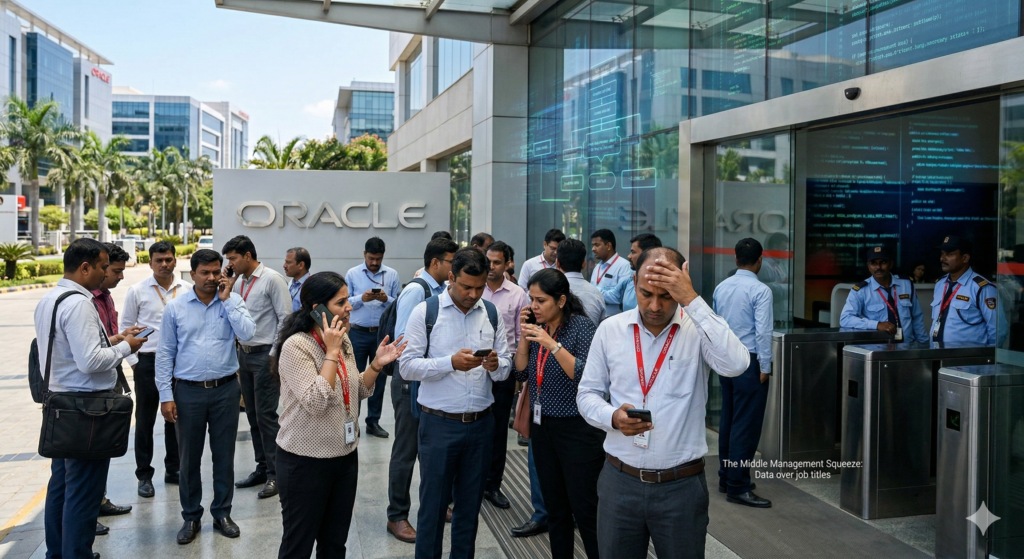
The roles that once absorbed fresh graduates — data processing, basic documentation, support coordination, junior analysis — are being quietly reshaped. Not eliminated overnight. Not replaced dramatically. But compressed, automated, streamlined. Artificial intelligence is not removing ambition; it is removing repetition. And that shift matters most at the bottom of the career ladder.
Think about what an entry-level management trainee used to do in their first year on the job. They compiled reports. They maintained trackers. They prepared meeting summaries. They ran basic market research. They formatted presentations. They processed data across Excel sheets. These were the building blocks of early professional experience — the tasks through which young managers understood how businesses actually worked, built confidence, and proved their worth before moving to higher-order responsibilities.
Many of the tasks that traditionally helped young professionals learn on the job — note-taking, initial drafts, basic research — are now the first to be automated or augmented by AI, raising concerns about building experience in roles that reward maturity, judgment, and contextual understanding.
This is the precise nature of the problem. It is not that management as a profession is dying. It is that the on-ramp into that profession — the entry-level role through which a graduate developed into a competent manager — is being drastically compressed. And the graduates who expected that on-ramp to look the same as it did five years ago are finding it has been rerouted.
The Skills Gap That Makes This Worse
Here is where the NASSCOM data becomes really uncomfortable.
According to NASSCOM, AI-related job demand in India is projected to cross 1 million by 2026. But as of recent estimates, only around 16% of IT professionals are AI-skilled. Now transfer that reality to the management graduate population — where AI literacy is far lower than even in the technology sector — and the gap becomes staggering.
The India Graduate Skill Index 2025 found that only 42.6% of graduates are employable, while the India Skills Report painted a slightly better picture with a 54.8% employability rate — but that still means nearly half of graduates are not job-ready.
The reasons are structural, and educators need to own them rather than explain them away.
Most Indian universities are still teaching a syllabus designed for yesterday’s jobs. While global industries are moving toward AI, data science, and cloud-native development, students are often taught legacy systems. Graduates may know the definitions of machine learning, but ask them to build a real-world application, and many stumble.
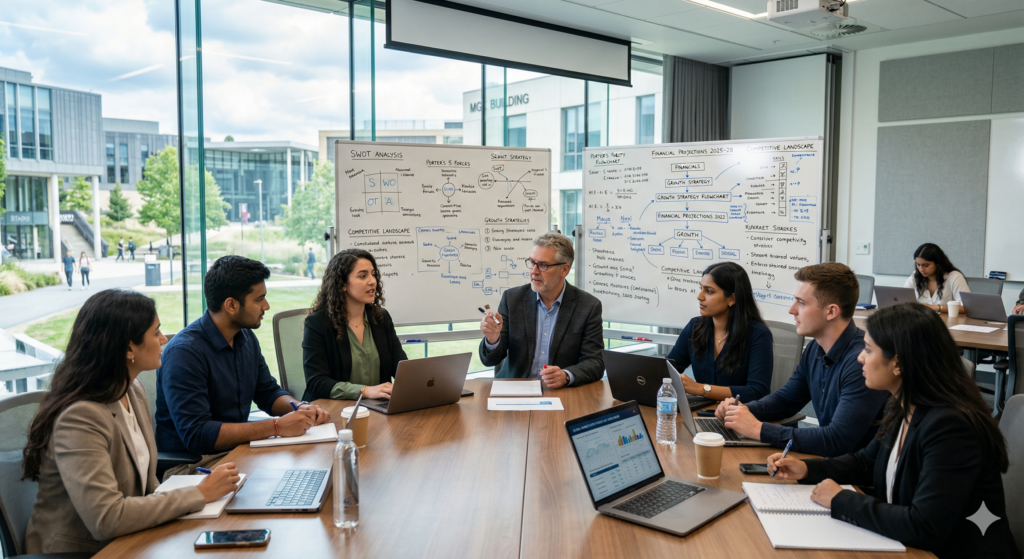
Management education in India has the same problem. Students learn Porter’s Five Forces. They learn organisational behaviour frameworks developed in the 1970s. They learn financial ratios that AI tools now calculate in seconds. And they graduate with zero practical understanding of how to use AI as a tool for business decision-making — let alone how to lead teams that work alongside intelligent systems.
The industry has moved. The curriculum has not kept up.
The Paradox: Danger and Opportunity at the Same Time
Here is what makes this moment genuinely fascinating rather than simply alarming.
India leads global AI talent hiring growth above all other nations. AI-fluent professionals earn a 56% wage premium over non-AI peers globally.
LinkedIn Economic Graph indicators show strong momentum, with India recording close to 100% year-on-year growth in prompt-engineering talent in 2025 and a hiring rate of AI engineering talent at 30%, placing it ahead of several advanced economies.
So the opportunity is real. The market is hungry for AI-literate management professionals. The problem is not that those jobs do not exist. The problem is that the education system is producing graduates who are not equipped to walk into them.
AI and ML engineering roles saw 600% growth in job availability even as MBA graduate employability declined. That contrast tells you everything about where the gap is — and where the opportunity lies for students who choose to close it.
Tasks once seen as core to post-MBA roles — like financial modelling, operational analysis, and market research — are increasingly being handled by AI-powered tools. But this also creates a new kind of opportunity: MBA-trained professionals who can speak the language of both business and technology are uniquely positioned to become the linchpins of innovation and transformation.
The future is not AI replacing managers. The future is AI-fluent managers replacing AI-resistant ones.
A Faculty Perspective: What Management Education Needs to Do Right Now
From where we stand inside management education at UKS, this is not an abstract policy debate. It is a practical and urgent question that we face every time we design a semester, bring in a guest speaker, or evaluate what our students should be able to do before they leave us.
Let us be direct about what needs to change — and what we are doing about it.
First, AI literacy cannot be a standalone elective. It cannot be the optional add-on module that students attend casually at the end of the semester. It has to be woven into every subject — marketing, finance, operations, human resources, strategy. Every discipline now has an AI dimension, and students need to see that integration, not treat AI as a separate subject that “tech people” worry about.
A marketing student needs to understand how AI personalises customer journeys and what that means for brand strategy. A finance student needs to know how algorithmic models are reshaping credit assessment and what that means for human judgment in lending. An HR student needs to understand how AI screening tools work — and also when they fail, and what the ethical stakes are. This is not optional. This is the baseline.
Second, practical tool exposure has to replace theoretical familiarity. Knowing that generative AI exists is useless. Knowing how to use it — for competitive analysis, for business writing, for scenario modelling, for customer insight generation — is a competency that directly affects employability. Our students should be graduating having used these tools in live project settings, not having read about them in textbooks.
The NASSCOM-Deloitte report on advancing India’s AI skills recommends that industry and academia foster collaboration to develop a skill pipeline — integrating foundational AI coursework into academic programs and establishing training programmes relevant to the industry, with a mix of theoretical knowledge and practical applications through courses, workshops, hackathons, and internships. That is exactly the direction quality institutions must move in — and move in fast.
Third, we need to teach students what AI cannot do — because that is where their value lives. AI is extraordinarily good at pattern recognition, data synthesis, text generation, and repetitive analysis. It is poor at ethical judgment, relationship management, cultural context, genuine empathy, and creative strategy rooted in human insight. The future manager is not a coder, nor someone replaced by AI — they are an orchestrator. A skilled manager decides what to automate, protects ethical guardrails, balances AI efficiency with human empathy, and drives innovation through AI augmentation.
Teaching students to think like orchestrators — not like task-executors — is the fundamental shift management education needs to make.
So What Does This Mean for a BMS Student Today?
If you are currently in a BMS programme, or considering one, this landscape should not scare you off management education. It should sharpen your approach to it.
Here is the honest reality: a BMS or management degree from a quality institution — one that is already integrating AI literacy, practical projects, and industry exposure into its curriculum — positions you better than ever. Because the market is not rejecting management graduates. It is rejecting underprepared ones.
Recruiters in 2026 do not debate degree labels. They evaluate skill architecture. Can you build and interpret predictive models? Use AI tools for business decision-making? Design AI-integrated strategies? Lead cross-functional AI-enabled teams? If yes, you are employable. If not, the credential label will not save you.
What that means practically for you right now:
Do not wait for your institution to hand you AI skills. Start engaging with these tools yourself. Use ChatGPT, Gemini, or Copilot to help you analyse case studies. Use AI-powered dashboards to understand market data. Explore how AI is being used in your intended industry. Build the fluency informally while your formal education builds the foundation.
Ask your institution hard questions. Does the curriculum reflect how businesses actually operate in 2026? Are there live projects where you apply learning to real companies? Do faculty members themselves use AI in their own research and teaching? Does the programme have industry partnerships that keep it honest about what employers want?
And understand that the human skills AI cannot replicate — your ability to build trust with clients, to navigate a difficult stakeholder conversation, to read a room, to lead a team through uncertainty — are not soft skills anymore. They are premium skills. Communication, negotiation, persuasion, and relationship-building are becoming more important, not less precisely because AI is handling the tasks that used to crowd these skills out.
The management graduate who combines business fundamentals with AI fluency and strong human judgment is exactly the professional the market is desperately trying to find. There are not enough of them. That scarcity is an opportunity — if you choose to claim it.
The Bottom Line
India stands at a pivotal point in its AI journey. The opportunity is immense — AI could unlock an estimated $621 billion, roughly 18% of India’s GDP — but it demands coordinated action on the Human Capital question and a robust roadmap for the AI-led workforce transition.
Management education sits right at the centre of that transition. The institutions that understand this — that are actively redesigning how they teach, what they teach, and why — will produce the graduates who lead that wave. The ones that do not will produce the statistics we quoted at the top of this article.
At UKS, we know which side of that line we want to be on. And we are building the kind of programme that ensures our students are not just employable by yesterday’s standards — but genuinely ready for the economy that is already here.
The question for every prospective management student is simple: Is the institution you are choosing asking that question too?
Sources: India Skills Report 2026 | NASSCOM AI Talent Reports | Deloitte-NASSCOM AI Skills Report | BusinessConnect India