
Oracle Cut 12,000 Managers in India Before Lunch. What Does That Tell Young MBAs?

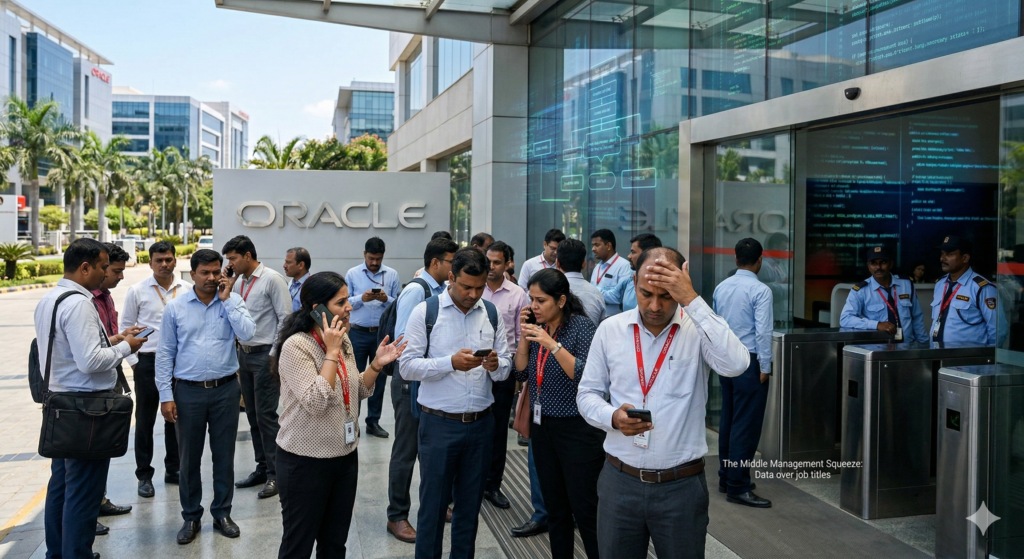
One Tuesday morning, 12,000 Oracle managers in India received an email they didn’t expect. By afternoon, their access cards no longer worked. No performance reviews. No warning. No town hall. No severance conversation. Just a calendar block that disappeared and a laptop that wouldn’t connect to the VPN. Just — gone.
The news spread faster on LinkedIn than it did internally. Former colleagues were posting condolences before some of the affected managers had even fully processed what had happened. By evening, the story was everywhere. By the next morning, the conversation had already shifted from shock to something more uncomfortable: not surprise, but recognition. Because somewhere deep down, a lot of people in corporate India had seen this coming. Not necessarily at Oracle, not necessarily on that Tuesday, but in the general direction of things. The middle layer of management — bloated, expensive, and increasingly difficult to justify — had been living on borrowed time.
This is not just a story about Oracle. Oracle is just the company that made the cut visible. This is a story about what the middle layer of corporate India has quietly become over the last decade: a holding pattern for people with good degrees, decent salaries, and jobs that were always more about coordination than creation. It is a story about the MBA, and what it was designed for, and whether that thing still exists.
The middle manager was invented for a world that needed human routers. In the pre-digital corporation, information did not flow freely. A senior leader in Mumbai could not know what was happening on the ground in Pune without someone physically in Pune who would collect that information, synthesize it, format it into a report, and send it up the chain. That person was the middle manager. They existed because information was expensive to move, and humans were the only pipes available.
Then came enterprise software. Then came dashboards. Then came real-time data. Then came Slack, and Notion, and tools that let a CEO see exactly how many support tickets were resolved this week without asking anyone. The information routing function — the core justification for an entire layer of corporate hierarchy — became automatable. And yet the managers remained. They remained because organizations are slow to restructure, because removing people is politically difficult, because middle managers are often the ones who decide whether to remove middle managers, and because for a long time the cost of keeping them was lower than the disruption of letting them go.
That calculus has now changed. AI changed it. Not because AI is doing the managers’ jobs exactly — not yet, not entirely — but because AI has made the question unavoidable. When a company can deploy an AI agent that monitors project timelines, flags risks, summarizes status updates, and routes decisions to the right person, the question is no longer whether the middle manager is valuable in theory. The question is: what does this specific person do that the agent cannot? And for 12,000 people at Oracle, the answer was apparently not enough.
This should terrify a generation of MBA students. And it should also clarify something for them — because the terror is only useful if it points toward something actionable.
The MBA as a credential was built around a set of assumptions that made sense in the 1980s and are now actively misleading. The assumption that managing a team is itself a valuable skill, regardless of what the team produces. The assumption that knowing how to read a balance sheet is sufficient financial literacy. The assumption that strategy is something that happens in boardrooms over three-day offsites rather than in the product sprint on a Tuesday afternoon. The assumption, most dangerously, that the degree confers a kind of durable employability — that once you have the two letters after your name, the organization owes you a career arc.
None of these assumptions are safe anymore. Not one.
What the Oracle layoffs actually revealed is that there is now a hard line being drawn inside corporate organizations between people who create leverage and people who consume it. A manager who runs three weekly check-ins, maintains a project tracker, writes summary emails to senior leadership, and approves timesheets is consuming organizational leverage. They are a cost center dressed up as a function. An AI agent with the right integrations can do all of that, around the clock, without a salary, without a leave policy, without a performance review cycle of its own.
A manager who can look at a dataset and see a business decision that no one else has seen yet — that person creates leverage. A manager who can sit across from a client who is angry and confused and leave the room with a renewed relationship and a signed contract — that person creates leverage. A manager who can take a product that works technically and figure out why no one is using it, and redesign the go-to-market from first principles — that person creates leverage. These are not things that current AI can replicate. They require judgment, context, and a quality of human presence that has no algorithmic substitute yet.
The new-age MBA needs to be built around this distinction. Not around management as a discipline, but around irreplaceability as a discipline. And irreplaceability in 2025 has three components that are worth examining seriously.
The first is data fluency — and it is important to understand what this means, because most MBA programs have convinced themselves that teaching Excel and Power BI constitutes data literacy. It does not. Data fluency in the current environment means understanding how models work well enough to know when they are wrong. It means being able to look at an AI-generated forecast and know which assumptions to interrogate. It means understanding the difference between correlation in a training dataset and causation in a business context. It means being dangerous enough with SQL to pull your own numbers when the analyst is busy, and being critical enough of dashboards to know what they are not showing you. This is not a technical skill. It is an epistemological skill. It is knowing how to know things, and knowing the limits of the tools that claim to know things for you.
The second is cross-functional speed. The organizational chart is a fiction that corporations maintain for reporting purposes. Real work happens across functions, in the gaps between boxes, in the conversations that don’t have a formal owner. The people who thrive in modern organizations are the ones who can move through these gaps — who can sit with an engineer and understand what they’re building, then sit with a customer and understand what they need, then sit with a finance person and understand what’s actually possible, and then synthesize all of that into a decision that moves something forward. This is not a generalist skill in the diluted sense — it is not about knowing a little of everything. It is about being able to switch contexts without losing sharpness, and about being genuinely comfortable with the ambiguity that lives between functions. MBA programs teach functional silos: your marketing module, your operations module, your finance module. The real skill is the whitespace between the modules, and most programs don’t teach that at all.
The third, and hardest, is judgment — and this is the one that no curriculum can fully deliver, but that every MBA program should at least be honest about. Judgment is the ability to make good decisions under conditions of genuine uncertainty, where the data is incomplete, where reasonable people disagree, where the stakes are real and the clock is running. It is built through experience, through failure, through exposure to consequences. It cannot be taught through case studies alone, because case studies have the answer at the back. Real business problems do not. The young professional who has only ever worked in environments where there is a right answer, where the framework produces the conclusion, is not building judgment. They are building a tolerance for frameworks. That tolerance will not protect them when the frameworks don’t apply.
There is something else worth saying, which is that the Oracle story is partly about India specifically — about the particular shape that the MBA-to-manager pipeline has taken in the Indian corporate context. India produces an enormous number of management graduates every year. The IIMs, the ISBs, the hundreds of business schools below them — they collectively release a vast cohort of credentialed professionals into the market annually, many of whom are extremely intelligent and extremely well-prepared for a version of corporate life that is becoming less real every year. The hunger to get into a large company, get the designation, manage a team, move up the ladder — this is a deeply ingrained aspiration in Indian professional culture, and it is an aspiration that was built for an economy that is restructuring away from it.
This is not a reason for despair. It is a reason for recalibration. The same intelligence, the same work ethic, the same competitive drive that fills MBA classrooms across India can be redirected — toward building things rather than just running them, toward owning outcomes rather than just reporting on them, toward developing a relationship with uncertainty that is curious rather than anxious. The opportunity is real. The Indian economy is not shrinking; it is changing shape. The roles that are disappearing are the ones that were always proxies for value rather than sources of it.
The MBA that will matter in the next decade is not a credential. It is a capability set. It is the ability to work with AI without being replaced by it. It is the ability to make decisions that AI cannot make. It is the ability to be in a room — physically, emotionally, intellectually — in ways that a model cannot replicate. It is, ultimately, the ability to be human in the specific ways that remain economically valuable, while being honest with yourself about which of your current activities are not.
Twelve thousand managers lost their jobs on a Tuesday morning in India. That is a real human cost, and it deserves to be named as such — not just as a data point in a restructuring story, but as twelve thousand people who had mortgages and school fees and career expectations that are now in question. That is serious and it matters.
But for the person sitting in an MBA classroom right now, or preparing for CAT, or deciding whether to take that mid-level manager role at a large tech company — the Tuesday morning in Bangalore is not a tragedy to observe. It is a question to answer. The question is simple, and it is the only question that matters in your career from this point forward: what do you do that cannot be automated, and how do you get so good at it that the question never has to be asked about you?
The algorithm learned to manage. The only response is to learn to do something the algorithm cannot.