Tourism Is Poaching IT Talent — Why Hospitality Is Now India’s Hottest White-Collar Career

Introduction: When the Tech World Starts Looking at Hotel Lobbies
Something quietly remarkable is happening in India’s professional job market. Software engineers are requesting lateral transfers into hotel revenue management. MBA graduates who were eyeing consulting are choosing resort operations instead. Mid-career IT professionals with five and seven years of experience are enrolling in hospitality management programmes to make a deliberate switch.
This is not anecdotal. A Travel and Tour World report making significant waves this week has documented what insiders in India’s hospitality sector have been observing for some time: the tourism boom is actively pulling talent away from information technology and into high-paying hospitality roles. Five-star properties are offering compensation packages in the ₹40–60 lakh range for experienced hospitality professionals. The IBEF Tourism Report reinforces the structural basis for this shift — India’s tourism economy is growing at a pace that is creating white-collar career opportunities that rival, and in several cases exceed, what the technology sector has traditionally offered.
For students currently choosing between career paths, and for parents advising them, this report deserves serious attention. The assumptions that have governed career counselling in India for the last two decades — that engineering and IT are the safe, high-earning defaults — are being challenged by data that is difficult to dismiss.
This blog unpacks what is driving this shift, what it means for compensation and career trajectory in hospitality, and why students who choose hotel management now are entering a profession that the market has decisively revalued.
The Report That Is Changing the Conversation
The Travel and Tour World report did not just note that hospitality is growing. It documented something more specific and more significant: that India’s tourism and hospitality sector has reached a compensation and career quality threshold that is making it genuinely competitive with sectors that have historically attracted India’s top graduate talent.
The numbers at the senior end of the hospitality career spectrum — ₹40–60 lakh annually at five-star properties for experienced professionals in general management, revenue management, sales leadership, and food and beverage direction — are not outliers. They represent what the market is paying to attract and retain qualified professionals in a context where qualified professionals are scarce.
This is the fundamental economics of a talent shortage at work. When a sector grows faster than its pipeline of trained professionals, compensation rises. That is not a temporary phenomenon — it is a structural condition that persists until training infrastructure catches up, a process that takes years.
The IBEF Tourism Report provides the macroeconomic foundation for understanding why this is happening now. India’s tourism sector contributes over 7% of GDP and is projected to become one of the top five tourism economies globally within this decade. Foreign tourist arrivals are recovering and growing. Domestic travel has permanently expanded its base. Business travel corridors are multiplying. And the hospitality infrastructure being built to serve this demand — over 550 new hotel properties in 2026 alone — is creating thousands of professional-grade positions that need to be filled by people with genuine expertise.
Why IT Professionals Are Making the Switch
To understand why experienced IT professionals are moving toward hospitality, it helps to understand what draws them — and what that says about how the profession has changed.
The Compensation Gap Has Narrowed Dramatically
For most of the 2000s and 2010s, the compensation argument for IT over hospitality was straightforward. A software engineer with five years of experience at a reputable company in Bengaluru or Pune would earn more than most hospitality professionals at equivalent experience levels, with more predictable increments and clearer upward mobility.
That gap has narrowed significantly at the mid-to-senior level of hospitality. A Revenue Manager at a five-star chain property in a major metro, a Director of Sales at a luxury resort, or a General Manager of a premium mid-scale hotel is now earning compensation that sits comfortably alongside what a senior software professional with equivalent experience would earn. When you factor in the additional benefits that come with senior hospitality roles — accommodation, meals, travel, international transfer opportunities, and in many cases company-provided vehicles — the total compensation picture becomes even more competitive.
The ₹40–60 lakh figure cited in the Travel and Tour World report is not the average — it is the achievable ceiling for experienced professionals in leadership roles. But the trajectory that gets you there from a strong hotel management education is increasingly clear and increasingly fast, particularly in the current demand environment.
IT Has a Ceiling Problem. Hospitality Has a Scale Problem.
One of the structural frustrations that drives mid-career switches out of IT is the ceiling effect. After a certain point in the technology career ladder, upward mobility becomes heavily dependent on managerial transitions, technical specialisation in areas that are rapidly being automated, or entrepreneurship. The craft of software development, for many practitioners, stops scaling financially after a certain level.
Hospitality has the opposite problem, and that problem is currently an opportunity. The sector is scaling so fast that there are not enough trained professionals to fill the leadership roles being created. General Managers, Revenue Directors, Operations Heads, F&B Leaders — these roles are opening across hundreds of new properties simultaneously, and the experienced professionals who can fill them command significant market power.
For IT professionals who are mid-career and looking for environments where their organisational, analytical, and management skills translate into genuine leadership responsibility, hospitality offers something increasingly rare: an industry where the demand for capable people exceeds the supply, and where that imbalance is expected to persist for years.
The Nature of Work Has Changed
There is a deeper reason that hospitality is attracting professionals from knowledge sectors, and it has less to do with money than with the nature of the work itself.
Hospitality, at its best, is a deeply human profession. It requires emotional intelligence, cross-cultural competence, real-time problem solving, creativity, and leadership capability that no algorithm can replicate. It is one of the few industries where artificial intelligence and automation, however they evolve, cannot substitute for the human capacity to read a guest’s needs, manage a team through a crisis, or create a dining experience that someone remembers for years.
For professionals who entered IT expecting intellectual challenge but found themselves executing within narrow technical parameters, the breadth and humanity of senior hospitality roles represent a genuine draw. The General Manager of a five-star hotel is simultaneously a CEO, a brand custodian, a community leader, an operations director, and a service professional. The complexity of that role, and the satisfaction it offers, is not replicable behind a screen.
The Architecture of a High-Paying Hospitality Career
For students and parents who are unfamiliar with how compensation actually works in hospitality — how you move from a hotel management degree to a ₹40 lakh package — it is worth mapping the trajectory with clarity.
Entry Level: The Foundation Years
A hotel management graduate entering a five-star property or premium hospitality brand as a Management Trainee or Commis-level professional will start in the ₹3–5 lakh range in most markets, with accommodation and meals frequently provided. This is the stage where operational foundation is built — and where the speed of progression depends heavily on the quality of training received and the attitude brought to the work.
This entry level is often where students make a mistake in evaluation. They compare the starting salary to an IT fresher’s package at a product company in Bengaluru and conclude that hospitality pays less. That comparison is incomplete. The IT fresher is paying market rent, buying their own food, and commuting on their own cost. The hospitality professional in a five-star property is frequently housed, fed, and positioned inside a brand that will promote them based on performance over a timeline that, in the current demand environment, is significantly compressed.
Mid Career: Where Compensation Begins to Differentiate
At the three-to-five year mark, a hospitality professional who has performed consistently and taken on supervisory responsibility is operating at a compensation level that begins to diverge sharply from those who entered without professional training. Department heads, assistant managers, and specialist roles in revenue management and sales are earning in the ₹8–18 lakh range, with the exact figure depending on brand, location, and functional specialisation.
This is also the stage where the branching of career paths becomes most significant. Hospitality careers are not linear in the way that many people assume. A Food and Beverage professional can move into consulting. A Front Office professional can transition into revenue management. A Sales professional can move into hotel development. The cross-functional fluency that comes from working inside a hotel property creates genuine optionality that many single-function careers do not.
Senior Level: The ₹40–60 Lakh Conversation
At the eight-to-twelve year mark, for professionals who have progressed into General Management, Revenue Leadership, or senior functional roles at five-star properties and premium chains, the compensation conversation moves into the bracket that the Travel and Tour World report highlights. ₹40–60 lakh is not mythological at this stage — it is the market rate for people with the right combination of operational track record, brand exposure, and leadership capability.
And critically, in the current market, the talent scarcity at this level means that experienced professionals have negotiating power that is unusual in most sectors. Hotels are competing with each other for qualified senior talent. That competition drives compensation upward.
The Roles That Are Redefining Hospitality as a White-Collar Profession
Part of what is changing the perception of hospitality as a career is the expansion of what professional hospitality work actually looks like. The image of hospitality as primarily a service-delivery profession — however honourable that work is — no longer captures the full picture of what the industry demands and rewards.
Revenue Management: Hospitality’s Analytical Frontier
Revenue management — the discipline of optimising hotel room pricing, inventory allocation, and distribution strategy in real time — has become one of the most analytically demanding functions in any industry. Revenue Managers use data science, demand forecasting, competitive analysis, and pricing strategy in ways that rival the complexity of financial markets.
This role is in severe shortage. Revenue management requires a combination of hospitality operational knowledge and analytical capability that very few professionals have developed. Those who have it command compensation that reflects its rarity. And it is a role that, perhaps more than any other in hospitality, directly attracts professionals from analytical backgrounds in other industries.
Hotel Asset Management and Development
As private equity, family offices, and institutional investors have poured capital into India’s hotel sector, a new class of hospitality professional has emerged: the hotel asset manager. This is someone who understands the operational dynamics of a hotel property and can represent the investor’s interests in managing the relationship with hotel operators, evaluating capital allocation decisions, and tracking property performance.
This role is genuinely lucrative, strategically complex, and almost entirely invisible in popular discussions of hospitality careers. It is also one of the most natural destinations for hospitality professionals who develop strong financial and business acumen over their careers.
Guest Experience and Brand Leadership
At India’s premium and luxury properties, the architecture of guest experience has become a strategic function, not just an operational one. Experience Directors, Brand Ambassadors, and Lifestyle Curators are roles that combine hospitality craft, creative direction, and customer psychology in ways that are uniquely compelling for professionals who want work that is simultaneously rigorous and imaginative.
These roles are new enough that they are not yet widely understood as career destinations, but they represent some of the most interesting and well-compensated work that the modern hospitality industry offers.
Food and Beverage Entrepreneurship and Consulting
The explosion of India’s restaurant and food service sector has created significant demand for culinary and F&B professionals who operate as consultants, concept developers, and brand builders. A senior F&B professional with strong brand exposure and operational depth can build a consulting practice that services multiple properties and brands simultaneously — with income potential that a salaried role cannot match.
This is a career path that is increasingly accessible to hospitality professionals who combine operational credibility with the business literacy to position themselves as genuine strategic advisors to the industry.
The Geography of Opportunity: Where Hospitality Careers Are Being Built
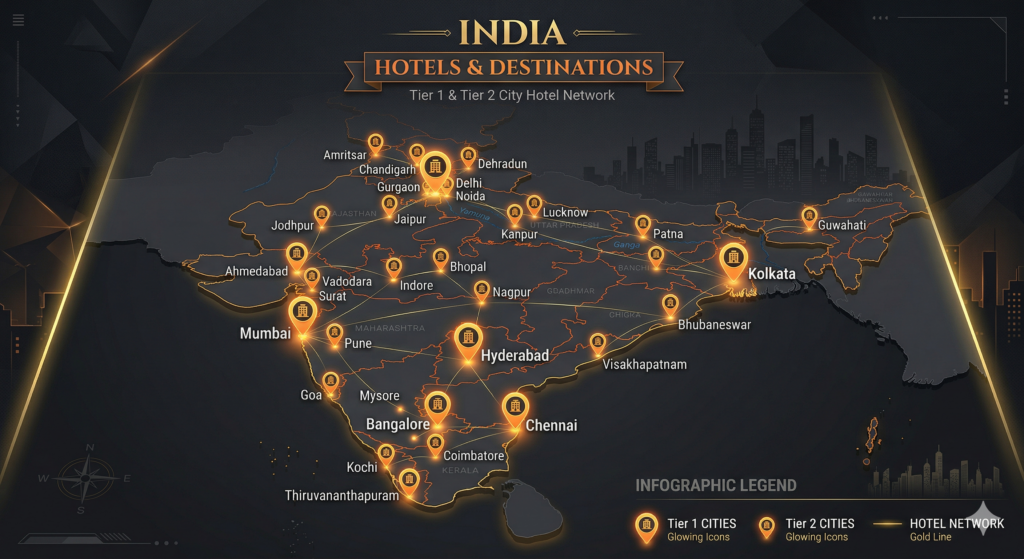
One of the most significant changes in India’s hospitality job market is geographic. For a long time, the highest-paying hospitality roles were concentrated in Mumbai and Delhi, with Bengaluru and Goa adding some depth. That concentration has broken apart.
Hyderabad has emerged as one of India’s most dynamic hospitality markets, driven by its growing status as a technology and pharmaceutical hub with corresponding demand for business travel accommodation and corporate hospitality.
Bengaluru continues to grow as a hospitality market as its tech economy draws international business and lifestyle spending.
Ayodhya and Varanasi are witnessing investment in hospitality infrastructure at a scale that reflects the enormous volumes of religious and heritage tourism that these destinations attract. The properties opening here represent career opportunities that would have seemed implausible a decade ago.
Goa, Rishikesh, Coimbatore, and Kochi are expanding as leisure and wellness destinations, with corresponding demand for hospitality professionals who can manage the unique operational demands of resort and experiential properties.
Tier 2 cities broadly — Indore, Bhopal, Raipur, Lucknow, Nagpur — are being targeted by mid-scale and upper-midscale chains as the next frontier of organised hospitality. These markets are creating management-level opportunities in cities where the cost of living is significantly lower than metros, effectively increasing the real value of compensation packages.
For students from smaller cities who have always assumed that the best hospitality careers required relocation to Mumbai or Delhi, this geographic expansion of the opportunity map is genuinely significant. The best careers are increasingly available closer to home.
What This Means If You Are a Student Choosing Your Path Right Now
The career counselling that many Indian students receive is built on assumptions that are becoming increasingly outdated. The idea that engineering or IT is the safe, high-ceiling default, and that hospitality is a backup or a passion-over-practicality choice, does not survive contact with the data that the Travel and Tour World report and IBEF Tourism projections put on the table.
Here is the honest comparison that students deserve to have access to:
A hotel management graduate entering a five-star property today is entering a sector growing at 9–12% annually, with a structural talent shortage that is expected to persist for years. The career trajectory from trained entry level to senior leadership, in this environment, is meaningfully faster than it would have been a decade ago. The compensation ceiling, for professionals who develop the right combination of operational depth, commercial acumen, and leadership capability, is in the ₹40–60 lakh range and above. The nature of the work is irreplaceable by automation. And the geographic optionality — the ability to work across India and internationally — is broader than almost any other profession offers.
An engineering graduate entering a mid-tier IT services company today is entering a sector facing genuine disruption from artificial intelligence and automation, where significant portions of the work traditionally done by junior and mid-level software professionals are being eliminated or substantially transformed. The high-compensation ceiling in IT exists, but it is increasingly concentrated in a narrowing band of specialisations and company types.
This is not an argument that IT is a bad choice. It is an argument that hospitality is no longer a lesser choice — and that for students who are drawn to the work, the business, and the people of this industry, the market has reached a moment where that choice is also the financially rational one.
RPH’s Perspective: Training for the Career That the Market Is Now Offering
At RPH, we have been preparing students for professional hospitality careers for years. What is different now is not what we are teaching — it is the market that our graduates are walking into.
The conversation about hospitality compensation that used to require careful framing and significant context now speaks for itself. When a Travel and Tour World report is being shared in career and education communities because it documents IT professionals switching to hotel roles for better pay and career quality, the case for hospitality as a serious professional choice has been made by the market, not just by us.
What we offer is the training that allows graduates to access the best of what this market is offering. Not just the entry-level positions, but the trajectory toward the roles that command ₹40–60 lakh packages. That trajectory requires genuine operational competence, commercial literacy, leadership development, and the kind of professional polish that only comes from rigorous, real-world-oriented training.
Our programme is built around producing graduates who can walk into India’s best hotels, resorts, and food service operations and perform at a level that earns them the fast-track progression this market is currently offering trained talent.
Conclusion: The Smartest Career Choice in India Right Now Might Not Be What You Think
India’s tourism and hospitality sector has crossed a threshold. It is no longer the industry that offers passion over practicality. It is the industry that is offering both — and doing so at a moment when the structural conditions for outstanding careers, fast progression, and high compensation have never been more clearly aligned.
The IT professionals making the switch are not making an emotional decision. They are making a calculated one, based on where the growth is, where the talent shortage is, and where the compensation trajectory is heading.
Students who enter hotel management now — with the right training, from the right institution — are not choosing the unconventional path. They are choosing the path that the data is pointing toward.
The tourism boom is real. The talent shortage is real. The compensation is real.
The only question is whether you will be trained and ready when India’s fastest-growing white-collar career comes looking for you.
RPH offers hotel management and culinary arts programmes designed to produce graduates for the top tier of India’s hospitality industry. Speak to our admissions team about the 2026 intake, programme structure, and where our graduates are working today. The market is ready. Are you?