The Future of HR Is Digital: How UKS Institute Is Training the Next Generation of Tech-Savvy HR Leaders

The human resources function has always been about people. But in 2025 and beyond, the professionals who lead that function need to be as comfortable with dashboards and data pipelines as they are with performance conversations and policy design. Across India’s corporate landscape, organisations are accelerating their investment in HR technology — and the talent gap between professionals who understand these tools and those who do not has never been wider, or more financially significant.
At UKS Institute, Bunts Sangha’s flagship management institution, the PGDM HR program has been deliberately redesigned around this reality. The curriculum does not treat technology as an add-on. It treats it as a core leadership competency — because that is exactly what it has become.
Why HR Technology Is No Longer Optional
Five years ago, HR technology literacy was a competitive advantage. Today, it is a baseline expectation. Companies across BFSI, IT, manufacturing, healthcare, and retail are deploying integrated HRMS platforms, AI-driven recruitment engines, and real-time workforce analytics. HR professionals who cannot navigate these environments are not just less efficient — they are increasingly difficult to promote into strategic roles.
The shift is structural. HR has moved from an administrative cost centre to a data-informed strategic function. The Chief People Officer of a mid-sized Indian enterprise now sits on decisions involving workforce planning models, attrition prediction algorithms, and learning management system ROI. Understanding the underlying technology is not optional for anyone who wants to occupy — or influence — that seat.
ATS Systems and the New Reality of Recruitment
Applicant Tracking Systems have become the front door of every serious talent acquisition operation. Platforms like Workday, Keka, and greytHR automate job posting, resume screening, candidate communication, and pipeline management at scale. In organisations hiring hundreds of candidates per quarter, ATS platforms are not support tools — they are the recruitment function itself.
UKS Institute’s PGDM HR students engage with ATS logic from the first semester, learning how Boolean search strings work, how screening algorithms apply keyword filters, and — critically — how unconscious bias can be embedded in automated shortlisting if not actively managed. This dual understanding — technical and ethical — is precisely what modern HR leaders need to lead responsible hiring at scale.
HRMS Platforms: The Operating System of Modern HR
If ATS systems manage the front of the employee lifecycle, HRMS platforms manage everything from onboarding through exit. Systems like SAP SuccessFactors, Oracle HCM, and India-built solutions like Darwinbox and Zoho People integrate payroll, leave management, performance cycles, compliance tracking, and employee self-service into a single operational layer.
For HR professionals in India, proficiency in HRMS platforms is one of the clearest differentiators in salary benchmarking. Professionals with hands-on HRMS experience command a measurable premium, particularly in mid-market and enterprise organisations scaling their HR operations. The UKS PGDM HR curriculum incorporates live platform walkthroughs, configuration exercises, and case simulations built around real HRMS deployment scenarios — not just theoretical overviews.
This is what separates a digital HR management India-ready graduate from someone who has only read about these tools in a textbook.
AI-Driven Recruitment and the Ethics of Algorithmic Hiring
Artificial intelligence has entered the recruitment function at multiple levels — from resume parsing and candidate matching to video interview analysis and offer probability modelling. Tools that score candidates on cultural fit, engagement signals, or predicted tenure are already in active use at large Indian corporates and multinationals.
The opportunity is significant. AI can dramatically reduce time-to-hire, improve shortlist quality, and remove the fatigue-induced inconsistency from high-volume screening. But the risks are equally real. Biased training data produces biased outputs. Candidates from non-traditional educational backgrounds, career returners, and neurodiverse applicants can be systematically disadvantaged by systems optimised on historical hiring patterns.
UKS Institute’s program prepares students to deploy AI recruitment tools critically — understanding both their commercial logic and their societal implications. Graduates leave with the ability to evaluate vendor claims, audit model outputs, and design hiring frameworks that are both efficient and equitable.
People Analytics: The Discipline That Is Rewriting HR Strategy
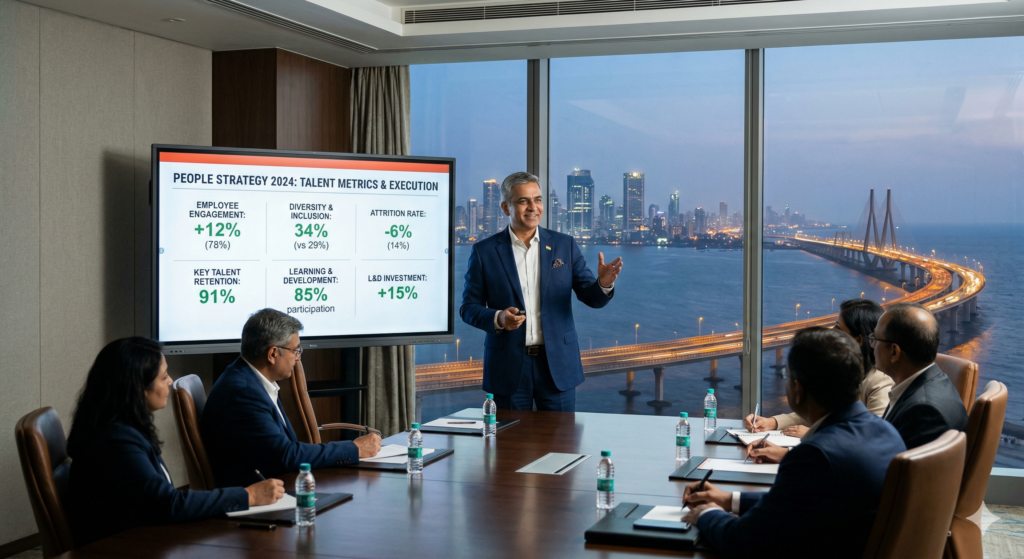
Of all the forces reshaping the HR function, people analytics is the most transformative. Organisations that can predict attrition before it happens, identify high-potential employees using behavioural signals, model the productivity impact of flexible work policies, and quantify the ROI of learning programmes are operating HR as a genuine strategic function — not a reactive one.
The demand for people analytics expertise in India is growing sharply. HR professionals who can work with data visualisation tools, interpret regression outputs, and translate workforce insights into executive recommendations are among the highest-compensated HR roles in the market. A people analytics MBA pathway is increasingly sought after by candidates who want to move into HR director, CHRO advisory, or workforce strategy consulting roles.
UKS Institute’s PGDM HR program integrates people analytics as a dedicated learning stream — covering data literacy, Excel and BI tool fundamentals, workforce metric design, and the interpretation of analytics dashboards. Students work on real datasets, building the muscle to move from data to decision with confidence.
Chatbot Onboarding and Remote Work Management Tools
The employee experience layer of HR technology has matured rapidly. AI-powered onboarding chatbots handle documentation queries, policy clarifications, and first-week scheduling at scale — freeing HR business partners for the relationship-building work that actually drives new hire retention. Tools like Leena AI and ServiceNow HR are already standard infrastructure at India’s major IT and BFSI employers.
Simultaneously, remote and hybrid work has made workforce management tools — covering productivity tracking, async collaboration, wellness check-ins, and virtual performance reviews — a permanent part of the HR toolkit. UKS Institute prepares students to design and manage the full digital employee experience, from pre-boarding to remote performance management, ensuring they can lead people operations in any working model.
Technology Fluency Accelerates Careers — The Data Is Clear
Research consistently confirms that HR professionals with technology expertise advance faster and earn more. In India’s HR job market, roles explicitly requiring HRMS proficiency, people analytics skills, or HR tech project leadership carry salary premiums of 20 to 40 percent over equivalent roles without those requirements. At senior levels, the gap widens further.
More importantly, technology-fluent HR professionals earn a seat at the strategy table. When an HR leader can present the board with a data model showing the talent risk in an acquisition target, or quantify the cost of a retention failure before it happens, they are no longer a support function. They are a strategic asset.
The UKS Institute Difference: Both Dimensions, Not One
What distinguishes UKS Institute’s approach is the refusal to treat HR technology as a replacement for people management expertise. The best HR leaders in the next decade will need both. They will need to understand sentiment before it shows up in a dashboard. They will need to design policies that algorithms cannot calibrate — around trust, fairness, belonging, and purpose.
The PGDM HR program at UKS Institute, affiliated with Mangalore University and embedded in Bengaluru’s talent ecosystem, trains graduates in the full spectrum: technology platforms and empathy, analytics and communication, automation and judgment. Industry mentors, live projects with corporate partners, and placement support that reaches into companies actively looking for digitally capable HR professionals all reinforce what the curriculum builds.
Build the Career That the Future of HR Demands
The organisations hiring HR leaders in 2025 are not looking for administrators. They are looking for strategists who understand people and the systems that support them. If you want to lead in that environment — in India’s most dynamic organisations — the time to build those skills is now.
Explore the PGDM HR program at UKS Institute. Visit uks.bunts.edu.in to learn more about the curriculum, industry partnerships, and how to apply.