Marketing in 2025 Is Data, AI, and Creativity Combined — UKS Institute Is Training the Marketers Who Can Do All Three


The marketer who thrives in 2025 is not the one who is best at writing copy, or the one who is best at reading dashboards. It is the one who can do both — who can look at a predictive analytics report, identify an audience insight buried in the data, and then craft a campaign idea that makes that insight come alive in a way that moves people.
This is the new definition of marketing excellence. Not creativity alone. Not data fluency alone. The combination of both, supercharged by artificial intelligence tools that are reshaping how brands communicate, target, personalise, and measure everything they do.
India is at the centre of this transformation. With one of the world’s fastest-growing digital economies, a consumer base that spans metros and Tier-3 towns, and brands investing more aggressively in marketing technology than ever before, the demand for AI-literate, data-fluent, creatively driven marketers has never been higher — and the supply has never been more inadequate.
UKS Institute of Management Studies, Mumbai, is directly addressing that gap. Here is how the marketing landscape is changing, and exactly how UKS is training the graduates who will lead it.
AI Is Not Replacing Marketers — It Is Separating the Good Ones From the Great Ones
Artificial intelligence in marketing is no longer a futuristic concept reserved for Silicon Valley tech companies. It is live, operational, and already changing how Indian brands connect with their customers every single day.
Personalisation at scale — serving each customer a message tailored to their behaviour, preferences, and purchase history — was once possible only for companies with massive technology teams. AI has democratised it. Platforms like HubSpot, Salesforce Marketing Cloud, and MoEngage now allow mid-sized brands to build dynamic customer journeys that adapt in real time based on how a user interacts with every touchpoint.
AI-generated content has entered the mainstream. Tools like Claude, ChatGPT, Jasper, and Canva’s AI features are being used by marketing teams to accelerate content production — drafting ad copy variations for A/B testing, generating personalised email subject lines, building social media calendars, and producing first-draft blog posts that human marketers then refine and elevate. The marketer who knows how to direct and edit AI-generated content is dramatically more productive than the one who does not know these tools exist.
Predictive customer analytics is another frontier that is already transforming how brands allocate their marketing budgets. Machine learning models trained on purchase history, browsing behaviour, and demographic data can now predict which customers are likely to churn, which are ready to upgrade, and which new prospects most closely resemble a brand’s highest-value existing customers. This is the AI in marketing MBA India recruiters are looking for — graduates who understand not just what these tools do, but how to act on what they tell you.
Programmatic Advertising, Chatbots, and Sentiment Analysis: The Infrastructure of Modern Marketing
Three technologies in particular are becoming non-negotiable knowledge for any serious marketing professional in 2025.
Programmatic advertising — the automated buying and placement of digital ads using real-time bidding and audience data — now accounts for the vast majority of display advertising spend globally. A marketing manager who cannot navigate a demand-side platform, set audience parameters, or interpret a programmatic campaign report is operating with a critical blind spot.
Chatbot marketing has evolved from clunky FAQ bots to sophisticated conversational interfaces that qualify leads, personalise product recommendations, recover abandoned carts, and handle customer service at scale — all without human intervention. WhatsApp Business API-powered chatbots are particularly transformative for Indian brands, where WhatsApp is the dominant messaging platform with over 500 million active users.
Sentiment analysis — using natural language processing to understand how customers feel about a brand, product, or campaign across social media, reviews, and customer feedback — gives marketing teams real-time intelligence that would have taken weeks of research to gather even five years ago. Brands that monitor and respond to sentiment data are catching reputation risks early and identifying opportunities their competitors miss entirely.
The data-driven marketing MBA graduate who understands these systems does not just understand marketing theory — they understand the actual infrastructure through which modern marketing operates.
Indian Brands Proving That Data-Driven Marketing Wins
The evidence is not abstract. Indian brands are already demonstrating what happens when creativity and data work together.
Nykaa built one of India’s most successful D2C brands on a foundation of content marketing, personalised email journeys, and data-led product recommendations — creating a shopping experience that felt curated rather than algorithmic, even though the algorithm was doing most of the work. Swiggy and Zomato turned real-time customer data into hyper-personalised notifications and campaigns that drove engagement rates that traditional broadcast marketing could never have achieved. Tata CLiQ, Myntra, and Meesho have all invested heavily in predictive analytics to reduce customer acquisition costs while increasing lifetime value.
The pattern across every one of these success stories is the same: a team of marketers who understood the data, had the creative instinct to act on it in compelling ways, and knew how to use the technology platforms that connected both.
The Tools That Are Reshaping Marketing — and That You Must Know
Marketing analytics MBA 2025 is not just an academic category. It is a skills inventory. The tools that define modern marketing competence include Google Analytics 4, which has fundamentally changed how marketers measure website behaviour and attribute conversions across a cookieless landscape. Meta Ads Manager, which requires genuine understanding of audience architecture, creative strategy, and performance diagnostics. HubSpot, the CRM and marketing automation platform that has become the operating system for thousands of B2B and B2C marketing teams. Looker Studio for building dashboards that turn data into decisions. And a growing ecosystem of AI content tools that accelerate production without sacrificing strategic thinking.
Understanding these tools at a surface level is no longer sufficient. Employers want graduates who have used them — who have built a campaign, read the results, identified what went wrong, and optimised accordingly.
Why the Most Valued Marketers Combine Creativity With Data Fluency
There is a persistent myth in marketing that creative people cannot be analytical and analytical people cannot be creative. The most successful marketing professionals of the current decade have comprehensively destroyed that myth.
The future of marketing India is being built by people who can sit in a data review, spot a counterintuitive insight about customer behaviour, and then walk into a creative brainstorm and use that insight to generate a campaign idea that no competitor has thought of yet. They are the marketers who understand that data tells you the what and the where, but creativity determines the how and the why — and that without both, you have either soulless automation or beautiful campaigns that reach the wrong people at the wrong time.
This combination — not creativity or data, but creativity and data, mediated by AI tools — is what defines the marketing analytics MBA 2025 landscape. It is what separates candidates who receive multiple offers from those who receive polite rejections.
How UKS Institute’s PGDM Marketing Prepares You to Operate at This Intersection
UKS Institute of Management Studies has built its PGDM Marketing programme around the explicit understanding that the future of marketing India belongs to graduates who are equally comfortable in a creative workshop and a data analytics session.
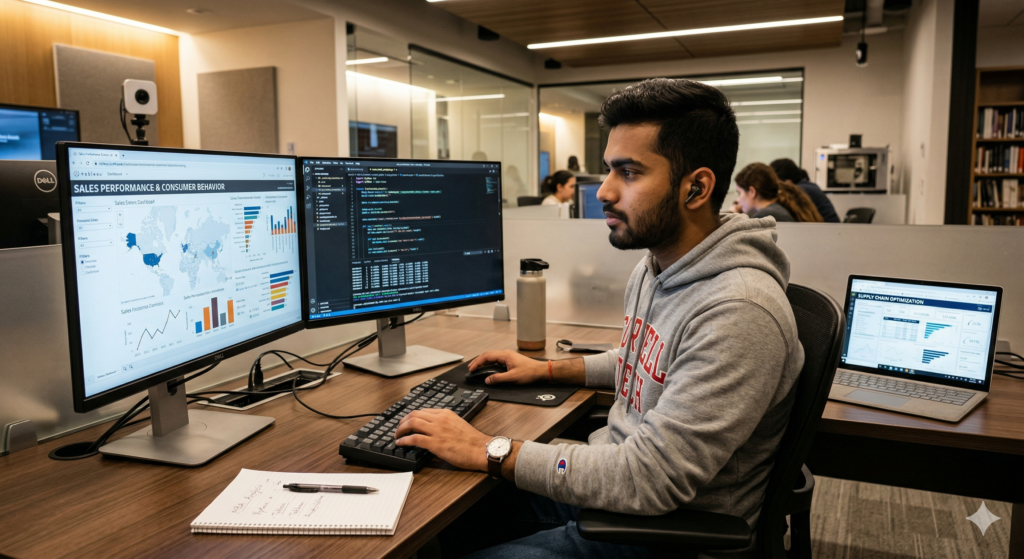
The curriculum integrates AI tools, analytics platforms, and live campaign execution from the first semester. Students do not encounter Google Analytics 4 or Meta Ads Manager in a theoretical context — they use them on real campaigns, building the muscle memory and judgement that comes only from actual practice. Marketing automation workflows are designed and built as coursework, not just discussed in lectures.
The AI in marketing MBA India components of the UKS curriculum include hands-on exposure to AI content generation tools, sessions on prompt engineering for marketing applications, and frameworks for evaluating when AI-generated output meets the standard required and when it needs human creative elevation. Students learn to work with AI as a collaborator, not a replacement — which is precisely how the best marketing teams in India are operating right now.
Faculty at UKS bring direct industry experience into the classroom — not just academic frameworks, but practitioner knowledge of how brands are actually using data, AI, and creativity together to build campaigns that convert. Guest sessions from marketing leaders across FMCG, EdTech, D2C, and agency sectors bring current industry reality directly into student learning.
The result is a graduate who does not need to be taught what HubSpot is when they join a marketing team. Who does not need to be walked through Google Analytics 4 on their first week. Who arrives already knowing how to read a Meta Ads dashboard, structure an A/B test, use an AI tool to generate copy variations, and present a data-backed campaign recommendation to senior leadership.
That is not just a better candidate — that is a candidate who delivers value from day one.
The Future Belongs to Marketers Who Refuse to Choose Between Art and Science
The false choice between being a creative marketer and being a data-driven marketer is one that 2025 has finally retired. The brands winning in India’s digital economy are not choosing between inspiration and intelligence — they are demanding both, simultaneously, from the people they hire.
UKS Institute of Management Studies is producing exactly those people. Graduates who can think boldly and measure precisely. Who can generate an idea and prove its worth. Who can use AI as a tool without losing the human judgment that makes marketing resonate.
If you want to be the marketer that brands in 2025 are competing to hire — visit uks.bunts.edu.in today. Explore the PGDM Marketing programme, speak with the admissions team, and take the first step toward a career at the intersection of creativity, data, and artificial intelligence. The future of marketing is being built right now. Be the one building it.