How to Choose the Right Undergraduate Course After 12th Commerce — A Complete 2026 Guide

CAREER GUIDANCE | FEBRUARY 2026
How to Choose the Right Undergraduate Course After 12th Commerce
A Complete 2026 Guide for Students & Parents — From B.Com to B.Sc IT
Published by Anna Leela College of Commerce & Economics and Shobha Jayaram Shetty College for BMS | Mumbai
Introduction: The Decision That Shapes Your Future
Completing your 12th standard in the Commerce stream is a massive milestone, but the question that keeps every student (and parent) awake at night is: “What next?” The choices you make right now will influence your career trajectory, earning potential, and professional satisfaction for decades to come.
The good news? Commerce graduates in India are thriving. From chartered accountancy to fintech, from digital marketing to data analytics, the career landscape has never been more diverse or exciting. The challenge, however, lies in choosing the right undergraduate course that aligns with your interests, strengths, and long-term goals.
In this comprehensive guide, we break down every major UG course available to Commerce students, compare them side-by-side, and give you a clear framework to make a confident, well-informed decision.
✨ Key Takeaway: Your degree is not a destination—it’s a launchpad. Choosing the right one accelerates your journey; choosing the wrong one just means a longer scenic route.
1. Understanding the Commerce Ecosystem in 2026
Before we dive into individual courses, it’s important to understand how the Commerce education ecosystem has evolved. The National Education Policy (NEP) 2020 has fundamentally reshaped undergraduate education in India, introducing flexible credit frameworks, multidisciplinary learning, and skill-based modules that make degrees far more practical and industry-relevant than before.

Today, a B.Com student can pick up data analytics electives, a BMS student can learn coding fundamentals, and a BAMMC student can specialize in digital strategy—all within their degree structure. Universities like Mumbai University, to which institutions such as Anna Leela College are affiliated, now offer NEP-aligned syllabi across all major programs.
This means your choice is no longer just about “which degree” but also about which combination of skills and specializations you want to build during your three undergraduate years.
2. Course-by-Course Breakdown
Let’s start with a quick comparison, then go deeper into each option:
| Course | Duration | Focus Area | Career Path | Ideal For |
| B.Com | 3 Years | Accounting, Tax, Economics | CA, CS, MBA, Banking | All-rounders |
| BMS | 3 Years | Management & Strategy | MBA, Corporate, Startups | Future leaders |
| BAF | 3 Years | Finance & Auditing | CA, CFA, Investment Banking | Numbers-lovers |
| B.Sc IT | 3 Years | Tech & Programming | Software Dev, Data Science | Tech enthusiasts |
| BAMMC | 3 Years | Media & Communication | Journalism, Advertising, PR | Creative minds |
| M.Com | 2 Years | Advanced Commerce | Academia, CFO roles | Deeper specialization |
2.1 Bachelor of Commerce (B.Com)
The B.Com remains India’s most popular undergraduate degree for commerce students—and for good reason. It provides a strong, well-rounded foundation in accounting, economics, taxation, business law, and financial management.
Who should choose B.Com? Students who want to keep their options open. B.Com is the perfect launching pad if you’re planning to pursue CA, CS, CMA, or an MBA afterwards. It gives you breadth without forcing early specialization.
Career opportunities: Banking, insurance, corporate finance, taxation consultancy, government services, and entrepreneurship.
✨ Key Takeaway: B.Com is the “swiss army knife” of commerce degrees—versatile, respected, and opens doors everywhere.
2.2 Bachelor of Management Studies (BMS)

BMS is designed for students who see themselves in leadership and management roles. The curriculum covers strategic management, organizational behavior, marketing, human resources, operations, and entrepreneurship. It’s essentially a mini-MBA at the undergraduate level.
Who should choose BMS? Natural leaders, debaters, event organizers, and anyone who gets excited by the idea of running teams, launching products, or building businesses.
Career opportunities: Management consulting, corporate strategy, product management, startup founding, HR, and operations management. BMS graduates also consistently perform well in MBA entrance exams like CAT.
✨ Key Takeaway: If you naturally gravitate towards leading group projects rather than doing them solo, BMS is calling your name.
2.3 Bachelor of Commerce in Accounting & Finance (BAF)
BAF is the specialized sibling of B.Com, going deeper into financial accounting, auditing, cost management, taxation, and financial markets. If B.Com gives you breadth, BAF gives you depth in the finance domain.
Who should choose BAF? Students who love numbers, enjoy solving financial puzzles, and are seriously considering careers in chartered accountancy, investment banking, or financial analysis.
Career opportunities: Chartered Accountancy, CFA, investment banking, equity research, financial planning, forensic accounting, and fintech.
✨ Key Takeaway: BAF students often clear CA Foundation on the first attempt because their coursework already covers so much of the syllabus.
2.4 Bachelor of Science in Information Technology (B.Sc IT)
In 2026, technology isn’t just an industry—it’s the backbone of every industry. B.Sc IT equips you with programming skills, database management, networking, cybersecurity fundamentals, and software engineering principles. Even commerce students can pursue this if they have the right aptitude.
Who should choose B.Sc IT? Students who are curious about how apps work, enjoy problem-solving and logical thinking, or want to combine business knowledge with technical skills.
Career opportunities: Software development, data science, cybersecurity, cloud computing, UX design, product management, and IT consulting.
✨ Key Takeaway: The intersection of commerce knowledge and tech skills makes B.Sc IT graduates uniquely valuable in fintech, e-commerce, and digital transformation roles.
2.5 Bachelor of Arts in Multimedia & Mass Communication (BAMMC)
Formerly known as BMM, BAMMC is the go-to degree for creative minds who want to work in journalism, advertising, public relations, film production, or digital media. The curriculum blends communication theory with hands-on production skills.
Who should choose BAMMC? Storytellers, content creators, photography enthusiasts, social media savants, and anyone who lights up when they see a great ad campaign or documentary.
Career opportunities: Journalism, content strategy, brand management, digital marketing, film production, public relations, event management, and social media management.
✨ Key Takeaway: In the creator economy of 2026, BAMMC graduates are building personal brands, launching media startups, and earning more than many traditional career paths.
3. The 5-Question Framework to Find Your Perfect Course

Still confused? Use this proven decision-making framework. Answer each question honestly, and by the end, your choice should become much clearer:
Question 1: What subjects excited you in 11th and 12th? If it was Accounts and Economics → B.Com or BAF. If it was Business Studies and Organization of Commerce → BMS. If it was creative projects and presentations → BAMMC. If it was anything tech-related → B.Sc IT.
Question 2: Do you prefer depth or breadth? Breadth (learning a little about everything) → B.Com or BMS. Depth (mastering one domain) → BAF, B.Sc IT, or BAMMC.
Question 3: What’s your 5-year career vision? CA/CS/CMA → B.Com or BAF. MBA → BMS or B.Com. Tech career → B.Sc IT. Creative industry → BAMMC.
Question 4: How do you learn best? Through theory and exams → B.Com. Through projects and presentations → BMS or BAMMC. Through labs and coding → B.Sc IT. Through case studies and problem sets → BAF.
Question 5: What role does campus placement play in your plan? If you want to start earning right after graduation, BMS and B.Sc IT typically have the strongest placement records. If you plan to pursue higher studies first, B.Com and BAF are excellent foundations.
4. Top 7 Mistakes Students Make When Choosing a Course
Avoid these common pitfalls that we’ve seen hundreds of students fall into:
- Following the crowd — Just because your friends chose BMS doesn’t mean it’s right for you. Your career is uniquely yours.
- Chasing “scope” without understanding it — Every course has excellent scope. The question is whether it has scope for YOU based on your skills and interests.
- Ignoring aptitude for passion — Passion is important, but aptitude matters too. Love marketing but struggle with presentations? You might need to build that skill first.
- Not researching the college — The same course at different colleges can offer vastly different experiences. Look for NAAC accreditation, placement records, faculty expertise, and infrastructure.
- Overlooking the NEP advantage — Under NEP, you can earn certificates and diplomas along the way. Understand how your chosen college implements NEP flexibility.
- Deciding based on fees alone — A slightly higher fee at a quality institution often pays for itself through better placements, exposure, and networking opportunities.
- Not talking to alumni — Current students and recent graduates can give you the most honest, unfiltered picture of what a course and college is really like.
5. The Power of Extracurriculars and Campus Life
Here’s something most guides won’t tell you: your degree is only about 60% of your college experience. The other 40% comes from everything else — cultural festivals, sports teams, NSS activities, industry visits, internships, and student clubs.
Employers in 2026 don’t just look at your transcript. They want to see evidence of teamwork, initiative, communication skills, and resilience. These qualities are forged through participation, not just academics.
When evaluating colleges, ask about their cultural events (many institutions host annual intercollegiate festivals), sports facilities, placement cells, and industry connections. A college that invests in holistic development will give you a competitive edge that no textbook can.
✨ Key Takeaway: The students who thrive after graduation are almost always the ones who were actively involved in campus life during their college years.
6. Future-Proof Skills Every Commerce Graduate Needs in 2026
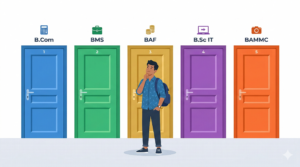
Regardless of which course you choose, make sure you develop these critical skills during your undergraduate years:
- Digital Literacy — Excel proficiency, basic data analytics, and familiarity with tools like Tally, SAP, or Python will set you apart in any field.
- Communication Skills — Writing clearly, presenting confidently, and negotiating effectively are non-negotiable in the modern workplace.
- Financial Literacy — Even if you’re in BAMMC, understanding personal finance, investing, and budgeting will serve you for life.
- Critical Thinking — AI can automate tasks, but it cannot replace the ability to analyze situations, question assumptions, and make sound judgments.
- Networking — Start building professional relationships early. Attend seminars, connect with alumni on LinkedIn, and participate in industry events.
- Adaptability — The jobs of 2030 may not exist today. A growth mindset and willingness to learn continuously is your greatest asset.
7. Final Thoughts: Your Journey Starts with One Decision

Choosing the right undergraduate course isn’t about finding a “perfect” answer—it’s about making an informed decision that you can commit to wholeheartedly. Every course listed in this guide can lead to a brilliant career if you bring dedication, curiosity, and the willingness to grow.
Take the time to research. Visit campuses. Talk to current students and alumni. Attend open days. And most importantly, trust yourself. You know your strengths, your passions, and your dreams better than anyone else.
The best time to start building your future was yesterday. The second best time is right now.
⭐ Ready to take the next step? ⭐
Admissions for 2025–26 are now open at Anna Leela College of Commerce & Economics.
Call: 022 2405 7249 / 022 2405 9012 | Visit: alsj.bunts.edu.in
Tags: #CommerceCareer #After12thCommerce #BComVsBMS #BAF #BScIT #BAMMC #MumbaiCollege #NEP2020 #CareerGuidance #ALSJ #AnnaLeelaCollege #UndergraduateCourses