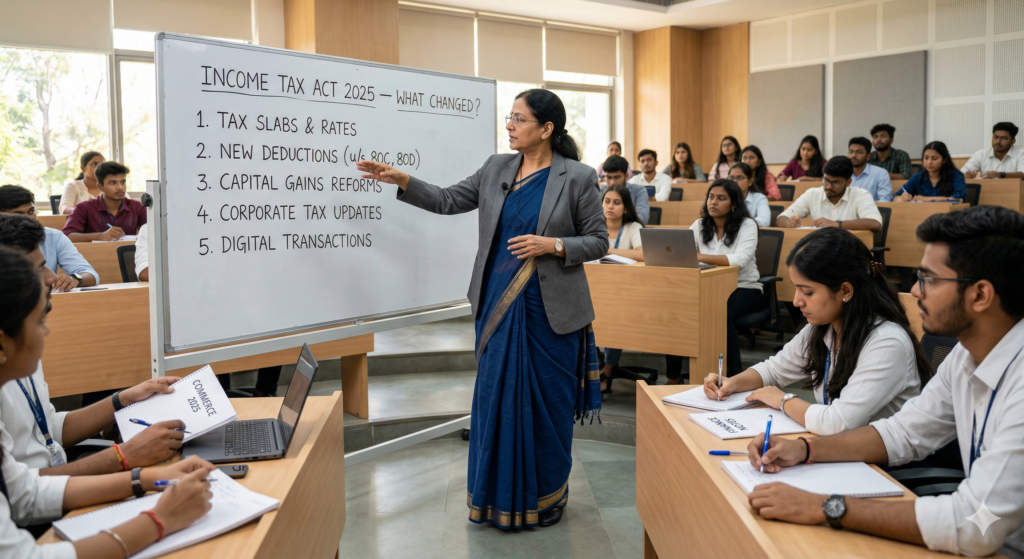
Maharashtra Just Approved a 4-Year Degree: How Mumbai University’s NEP Reform Changes Everything for Commerce Students

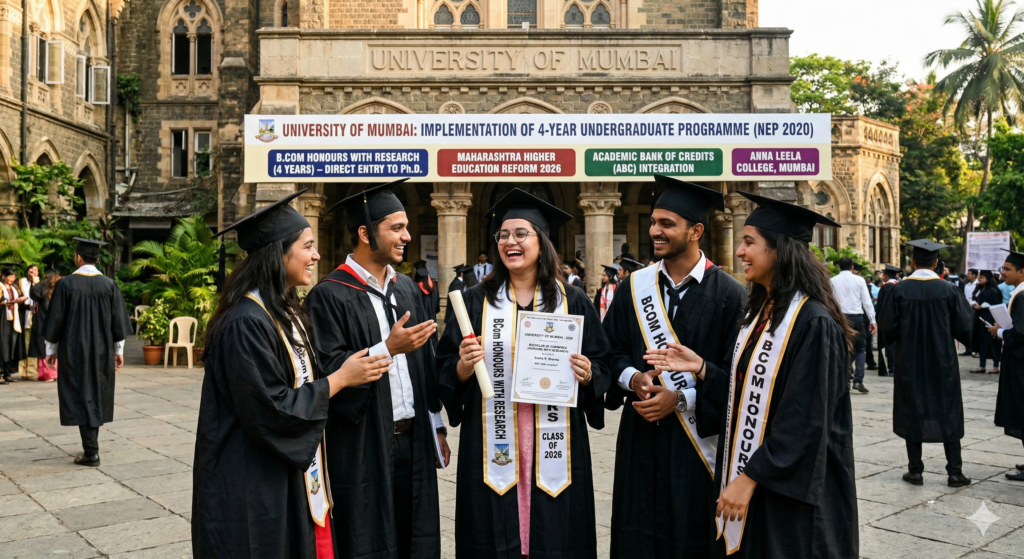
By a Faculty Member, Anna Leela College of Commerce & Management, Mumbai
Let me ask you something before we get into the details of what just changed.
When you tell someone you are doing BCom, what is the first thing they say? Nine times out of ten, it is something like — “Oh nice, what after that?” As if the degree itself is just a warm-up. A placeholder. A three-year waiting period before the real thing begins.
That perception — and I say this as someone who has spent years in commerce education — is not entirely wrong about the old system. A three-year BCom in India, with its limited scope for specialization and no research component, has for decades been seen as a stepping stone rather than a destination. It got you to the CA course, to MBA entrances, to a government exam, to an MCom. The degree itself was not the point.
That is now changing. And it is changing in a way that is directly relevant to every student sitting in a commerce classroom in Maharashtra right now.
On April 6, 2026, the Maharashtra government officially approved the implementation of four-year undergraduate programmes starting from the 2026-27 academic year, aligning the state’s higher education framework with the National Education Policy 2020. Minister of Higher and Technical Education Chandrakant Patil announced that the government has issued comprehensive guidelines for the introduction of Honours and Honours with Research degrees, with the decision aimed at shifting the academic landscape from traditional rote learning to a more research-oriented and skill-based model.
This blog is my attempt to explain, clearly and honestly, what this reform actually means — for BCom students, MCom aspirants, and everyone in between who is trying to figure out what the new structure of their education looks like and whether it is worth engaging with.
First: What Exactly Did Maharashtra Approve?
Let me lay out the structure clearly, because there is a lot of noise on this topic and not enough precision.
The four-year undergraduate programme will be structured into eight semesters, offering two options after completion of the third year: a standard honours degree, and an honours degree with research.
So let us be clear about what this means in practice. Your first three years remain broadly as they are. You complete them, you earn your credits, and at the end of Year 3, you have a decision to make. You can take your degree and leave — with a regular Bachelor’s degree — or you can opt to continue for a fourth year in one of two tracks.
Students opting for the Honours track will need to complete between 160 and 176 credits over four years, including an internship in the final year. Those choosing the Honours with Research option will be required to undertake a research project or dissertation worth 12 credits in their major subject.
Students must complete 120 to 132 credits during the first three years to qualify for entry into the fourth year of the Honours programme. Those opting for the Research track must secure a minimum cumulative grade point average of 7.5.
The 7.5 CGPA threshold for the Research track is significant. It is not an open-door entry. It is a merit-based filter, which means the Research degree will carry genuine academic weight. This is not a participation certificate. It is a credential that demands performance.
The number of seats available for the research stream will depend on the availability of recognised PhD supervisors, with each guide permitted to mentor up to five students. This keeps the programme intimate and genuinely supervised — which is exactly what research education requires.
Second: What Does This Mean for Mumbai University and Its Affiliated Colleges?
Mumbai University has approved guidelines for the fourth year of undergraduate programmes under NEP 2020. Students will be able to choose between Honours and Honours with Research tracks from the 2026-27 academic session.
For colleges affiliated to Mumbai University — including Anna Leela — the Government Resolution mandates that all public universities, as well as affiliated and autonomous colleges across Maharashtra, adopt the new four-year structure.
However, not every college will be able to offer all tracks immediately. Colleges offering only three-year undergraduate programmes will be required to obtain permission to start the fourth year. Institutions already offering postgraduate courses in the same subject will be allowed to introduce the fourth-year Honours programme automatically, while those with recognised PhD centres can also start the Honours with Research programme without additional approvals.
This is an important detail. If your college already has a functioning MCom programme, it can offer the BCom Honours fourth year. If it has a recognised PhD centre, it can offer the Honours with Research track. The infrastructure requirement is tied to the depth of the programme being offered.
The GR also mandates that all students register on the Academic Bank of Credits platform to facilitate credit transfer and enable multiple entry and exit options under the NEP framework. It also allows lateral entry into the fourth year at other colleges or university departments, subject to eligibility, seat availability, and the state’s reservation policy.
That last point is quietly significant. If your current college cannot offer the fourth year, you may be able to complete it at a different institution — including a university department — through the credit transfer mechanism. The system is designed to be flexible, not to trap you in whichever college you started in.
Third: The PhD Question — The One That Changes Everything
This is where I want to spend the most time, because it is the least understood benefit of this reform, and it is the one with the most transformative long-term implications for commerce students.
Under the old system, the academic pathway to a PhD in Commerce looked like this: BCom (3 years) → MCom (2 years) → PhD admission (through NET/SET and university entrance). That is a minimum of 8 years of higher education before you begin doctoral research — not including the PhD duration itself, which typically runs 3 to 5 years.
Under the NEP framework, students who opt for research in the fourth year and receive a UG Honours with Research degree can directly join PhD programmes without a postgraduate degree.
Read that again. A 4-year BCom Honours with Research — with the required CGPA of 7.5 — makes you eligible for PhD admission. You skip the MCom entirely. That is a two-year saving in your academic timeline — two years of tuition fees, two years of living expenses, and two years of opportunity cost.
According to UGC regulations, students with a minimum CGPA of 7.5 in the four-year undergraduate programme will be eligible for PhD admissions without having to complete a master’s programme.
For a student who is academically inclined, who genuinely wants to go deep into financial economics, accounting theory, business law, or commerce education — this is a structural acceleration of enormous value. You arrive at doctoral work younger, with a dedicated research project already under your belt, and with two additional years to spend on actual research rather than coursework repetition.
Fourth: The Global Recognition Dimension
Here is a comparison that I find useful when explaining this to students who are thinking about international careers or postgraduate study abroad.
Most top universities in the United States, United Kingdom, Europe, and Australia operate on a four-year undergraduate model. A student graduating from a US university with a Bachelor of Science in Finance after four years is the standard profile for admission to LSE, Harvard Kennedy School, Oxford’s graduate programmes, or any of the top international business schools. When Indian students with three-year degrees applied to these institutions, admissions committees frequently required an additional bridging year or raised questions about the degree’s equivalence.
A 4-year degree structure aligns with international education systems, and internships and skill-based learning improve job readiness. This alignment is not cosmetic. It changes how your transcript reads to an international admissions committee. A BCom Honours from Mumbai University — with eight semesters, 160-176 credits, and a research or internship component — is a fundamentally different document than a three-year BCom when evaluated by a foreign university.
Under the new framework, four-year degree courses will be aligned with the National Credit Framework. The fourth year, along with postgraduate diplomas and the first year of a two-year postgraduate course, will be recognised at NCrF level 6.0, enabling smoother academic progression for students.
NCrF Level 6.0 is India’s alignment with international credit frameworks. It means your degree sits at a globally recognized qualification level — which matters enormously if you are considering graduate school outside India or if you are being evaluated by a multinational employer for a role that requires an assessment of your academic credential.
Fifth: What the Honours Track Offers Even Without the Research Path
Not every commerce student wants to become a researcher or pursue a PhD. That is completely fine, and the Honours track — without the research component — is still a meaningfully different credential from a three-year degree, for reasons that are immediately practical.
The Honours track requires an internship in the final year. Students selecting the Honours track will need to complete between 160 and 176 credits over four years, which will include an internship in the final year.
For commerce students, that internship is not a formality. Done well, in a CA firm, a corporate finance team, a banking institution, or a tax consultancy, a final-year internship under the Honours structure gives you something that no classroom can: verified professional experience as part of your academic record. You graduate with both the degree credential and documented work experience in your field.
In an employment market where every shortlist is crowded with fresh graduates who all have the same marks and the same certifications, a structured internship embedded in your Honours programme is a genuine differentiator. Employers know what the Honours track requires. They know you had to perform academically to stay in it, and they know the fourth year included real-world exposure.
Sixth: The Academic Bank of Credits — Your Educational Portfolio
One of the less discussed but genuinely important features of this framework is the Academic Bank of Credits system that underpins it.
The NEP envisages an Academic Bank of Credits as an academic service mechanism established and managed by the Ministry of Education and UGC to facilitate students to become its academic account holders, enabling seamless student mobility between or within degree-granting institutions through formal systems of credit recognition, credit accumulation, credit transfer, and credit redemption.
What this means in practice: the credits you earn do not disappear if your circumstances change. The validity of credits earned and kept in the Academic Credit Account is seven years. If you exit after three years, take a break from academia, work for a year or two, and then decide you want to return for the fourth year — you can. Your credits are waiting for you.
This is a paradigm shift from the old system, where taking a break from education meant effectively starting over. The ABC system treats your education as a portfolio that you build over time, not a conveyor belt where missing one step sends you back to the beginning.
For commerce students in particular — many of whom balance education with CA articleship, family responsibilities, or economic pressures — this flexibility is not a minor administrative feature. It is a design principle that acknowledges the reality of how students actually live and study.
What Should Commerce Students at Anna Leela Do Right Now?
Let me be practical for a moment, because inspiration without direction is not particularly useful.
If you are entering BCom in 2026-27, you are the first cohort to navigate this new structure from the very beginning. That means you need to track your CGPA seriously from Semester 1. The 7.5 CGPA requirement for the Research track does not materialise at the end of Year 3 — it is built semester by semester over three years. Students who sleepwalk through Year 1 and try to rescue their average in Year 3 will find it mathematically difficult.
Start thinking early about what your fourth year looks like. If you want the Research track, identify your area of interest — financial markets, taxation, auditing, corporate governance, behavioural economics — because a good research dissertation requires a focused question and sustained effort. The earlier you start reading in your area, the better your dissertation will be.
If you want the Honours track without research, start networking for your internship from Year 2 onwards. The best placements go to students who have built relationships, not to students who start making phone calls in the final semester of Year 3. CA firms, Big 4 offices, corporate treasury teams, and consulting practices are the obvious targets for BCom Honours internships. But so are startups, NGOs with financial management needs, and government departments with finance and compliance mandates.
Register on the Academic Bank of Credits portal as soon as it is available to you. This is not optional — the GR mandates that all students register on the ABC platform. But beyond compliance, maintaining an active ABC account gives you a portable, nationally recognised record of your academic achievements.
What Should Current MCom Students Know?
This reform does not make your MCom degree obsolete. Let me be clear about that.
An MCom continues to have value — in government recruitment, in teaching eligibility at the school level, in certain professional pathways that require postgraduate qualification. Qualifying UGC NET based on a 4-year bachelor’s degree makes you eligible only for JRF and PhD admission, not for Assistant Professor positions. If becoming a college lecturer is your goal, you will still need a postgraduate degree, regardless of what your undergraduate credential looks like.
What the reform does is create a genuine alternative pathway for students who know by the end of their third year that they want to pursue research or doctoral work — allowing them to skip the MCom and go directly to PhD preparation. For those students, the Honours with Research track is a far more efficient route than the traditional BCom → MCom → PhD ladder.
For students who want to teach, manage, or practice in industry, MCom remains a valuable and recognized credential. The new system adds options — it does not subtract existing ones.
A Candid Note on Implementation
I would be doing a disservice to you if I presented this reform purely as a smooth, frictionless transition. It is not. While the reform is ambitious, it comes with challenges. Many colleges lack PG departments or research facilities. There is a need for faculty training and infrastructure development. There are transition issues for students already enrolled under the old system.
Not every college in Maharashtra will be ready to offer a high-quality fourth year from the very first session. Some will be scrambling to meet eligibility requirements. Some will have limited PhD-qualified faculty available as supervisors for the Research track. The quality of the fourth year will vary significantly by institution in the early years of implementation.
This is why the college you choose matters, and why the questions you ask during admissions matter. Does this college have an active MCom programme? Does it have a recognised research centre? How many faculty members hold PhDs in commerce-related disciplines and are recognized as supervisors? These are not pedantic questions — they are the conditions that determine whether your fourth year is genuinely valuable or merely a administrative box-ticking exercise.
At institutions with strong academic foundations — where faculty are actively publishing, where the MCom programme runs with rigor, where research culture exists — the fourth year will be genuinely transformative. At institutions that are implementing the structure without the underlying academic infrastructure, it will be thinner.
Choose accordingly. Ask these questions before you enroll. The reform gives you the framework. The institution gives it meaning.
The Longer View
India’s demographic reality is both its greatest advantage and its greatest challenge. We graduate millions of students every year from undergraduate programmes in commerce. The question has always been: what is the quality and depth of what those students actually know? Can they research? Can they contribute original thinking? Can they be trusted with complex financial analysis or taxation advisory without years of supervised work experience before they become independently productive?
The four-year Honours structure, if implemented well, begins to answer those questions differently. It produces graduates who have spent not just three but four years in deliberate academic formation — with research exposure, internship experience, and deeper specialization in their major field. It produces graduates who are more ready for the complexity of modern commerce practice, not just the mechanics of it.
For those of us who teach commerce — and who believe that commerce education matters, that it builds the professionals who keep economies running honestly and efficiently — this reform is long overdue. It is not perfect. Its execution will be uneven. There will be years of learning and adjustment ahead. But the direction is right.
And for students standing at the beginning of this new structure, uncertain about whether the fourth year is worth it, whether the research track is too demanding, whether the extra year translates to anything real in the job market — my answer is this: invest in depth. The market will always reward people who know something genuinely well over people who know many things superficially.
Commerce is not a subject you can skim. Taxation law, financial reporting, auditing standards, economic analysis — these are disciplines that reward rigour. The fourth year gives you the space and the structure to develop that rigour at a stage of your education when it compounds most powerfully.
Use it well.
See you in class.
Keywords: Maharashtra 4-year undergraduate degree 2026, Mumbai University NEP reform BCom, Honours with Research degree Maharashtra, NEP 2020 four-year UG programme commerce, BCom Honours PhD direct admission, Academic Bank of Credits Mumbai University, Anna Leela College commerce 2026-27, NEP Honours degree employability India, 4-year BCom degree benefits, Maharashtra higher education reform 2026