India to Add 550+ New Hotels in 2026 — And RPH Graduates Are First in Line for the Jobs

Introduction: A Hotel Boom Unlike Any Other
India’s hospitality industry is in the middle of a transformation that analysts are calling the most significant supply expansion in the country’s history. Over 550 new hotel properties are confirmed to open across India in 2026. Hilton has announced a landmark 125-hotel Hampton Inn rollout. Sector growth is officially projected at 9–12% for FY26 — and the trade press, from TravelBiz Monitor to BW Hotelier to Entrepreneur India, is tracking this story with the urgency it deserves.
But behind every headline about new properties, new brands, and new investment, there is a quieter, more pressing story: India does not have enough trained hospitality professionals to staff this boom.
And that changes everything for anyone considering a career in hotel management right now.
The Scale of India’s Hotel Expansion in 2026
To understand why this moment is different, you have to look at the numbers in full.
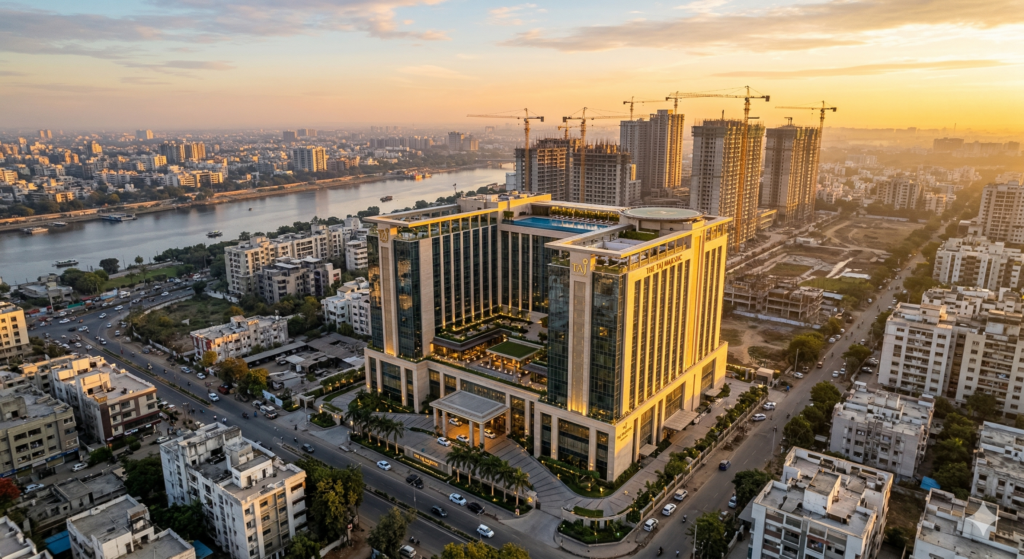
India currently has roughly 150,000 classified hotel rooms across branded properties. The 550+ new hotels coming online in 2026 alone represent a pipeline that would add tens of thousands of rooms to that inventory in a single calendar year. That pace of expansion has not been seen before in the Indian market.
The brands driving this push read like a who’s who of global hospitality. Hilton’s Hampton by Hilton expansion — 125 hotels committed to India — is the single largest brand rollout by an international chain in the country’s history. IHG, Marriott, Hyatt, Radisson, and a growing list of domestic chains like IHCL and Lemon Tree are simultaneously accelerating their own pipelines. Tier 2 and Tier 3 cities — Coimbatore, Indore, Kochi, Lucknow, Varanasi — are no longer afterthoughts. They are primary targets.
The reasons are structural, not cyclical. India’s domestic travel market has exploded post-pandemic. Business travel corridors are multiplying as manufacturing and services expand beyond metros. Religious and heritage tourism circuits are attracting unprecedented investment in hospitality infrastructure. And India’s growing middle class — now the world’s largest — is spending on travel experiences in ways that were unimaginable a decade ago.
This is not a bubble. This is a base that is being built for the long term.
The Talent Gap No One Is Talking About Loudly Enough
Here is the reality that every hotel developer quietly knows but rarely says in a press release: building a hotel is the easier part. Staffing it with trained, competent, guest-ready professionals is the harder challenge.
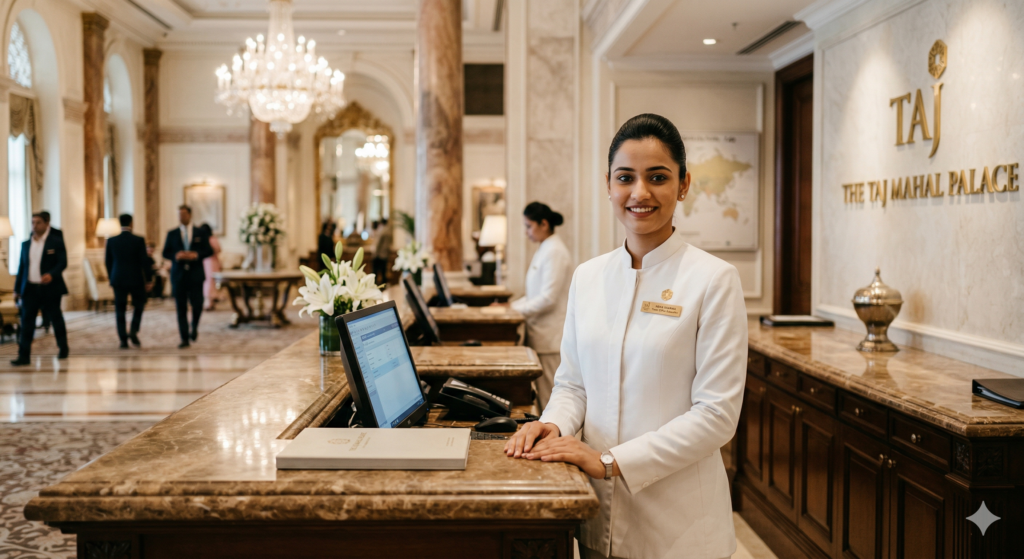
Every new hotel property requires a full organisational structure to function. A mid-scale hotel alone needs a General Manager, a Front Office Manager and team, a Housekeeping Head, an F&B Manager, a Banquets Coordinator, a Revenue Manager, a Human Resources executive, and a Sales team — before a single guest checks in. Multiply that across 550 properties, and you are looking at a demand for trained hospitality professionals that runs into the tens of thousands, just for 2026.
India’s hotel management institutions are not producing graduates at anywhere near that pace.
This is the talent gap. And for students, it represents one of the most favourable employment conditions the sector has ever created. When supply of trained professionals is low and demand from employers is high, the leverage shifts dramatically to the candidate. Salaries move. Designations accelerate. Career trajectories compress. What used to take five years to achieve becomes achievable in three.
Professor-level industry observers have been consistent in their assessment: the current moment is not just a good time to enter hospitality — it is the most strategically advantageous entry point the industry has offered in a generation.
Why Hotel Management Training Has Never Mattered More
There is a version of hospitality hiring that happens during slow growth periods. Hotels are cautious. They hire for bare minimum roles. They promote slowly. They have the luxury of patience.
That version does not apply to 2026.
When a Hampton by Hilton is opening in a Tier 2 city and needs a trained Front Office team in eight weeks, it does not have time to train someone from scratch. When a new five-star property in Hyderabad is onboarding 200 staff before its launch, it needs people who already understand service standards, brand protocols, guest handling, and operational SOP — not people who are still learning what a PMS software does.
This is why the nature of hotel management education matters so much right now. Not all programmes are equal. The difference between a graduate who is job-ready on Day One and one who needs six months of on-the-job orientation is the difference between a programme that trains for real operations and one that stops at theory.
The best hotel management institutions have always understood that hospitality is a performance industry. You are judged — by guests, by supervisors, by brands — on what you do in the moment, not on what you knew in a classroom. Practical training, live kitchen experience, front office simulations, industrial exposure, and the habit of service are not add-ons. They are the curriculum.
What RPH Graduates Bring to This Market
At RPH, we have built our academic model around a single, non-negotiable outcome: producing graduates who are operationally confident, professionally polished, and genuinely employable from the first day of work.
That means our students spend time in real kitchen environments, not just watching demonstrations. It means Front Office training happens in live simulation settings where protocols and guest handling are practised until they become instinct. It means Food & Beverage service is taught with the rigour that five-star brands demand. It means soft skills — communication, composure under pressure, cross-cultural guest sensitivity — are embedded throughout the programme, not added on at the end.
The result is a graduate who walks into a Marriott or a Hilton or a boutique resort and contributes from Week One. Not someone who spends the first quarter finding their footing.
India’s 550+ new hotels are not looking for potential. They are looking for performance. RPH graduates are trained to deliver exactly that.
The Cities Where Opportunity Is Opening Up
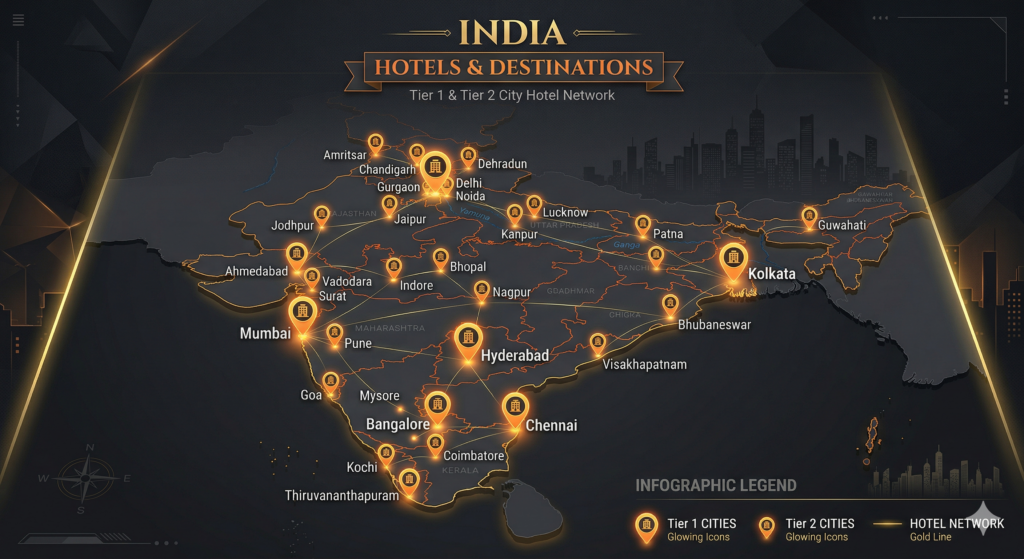
One of the most significant shifts in this boom is geographic. For decades, hotel management careers were centred around a handful of metros — Mumbai, Delhi, Bengaluru, Chennai, Kolkata. Those markets remain important. But the growth story of 2026 is being written in different places.
Ayodhya is seeing a hospitality surge tied to religious tourism that has drawn investment from India’s largest hotel groups. Varanasi is expanding its luxury and mid-scale inventory significantly. Coimbatore, Kochi, and Thiruvananthapuram are attracting both domestic and international brands. Indore, Bhopal, and Raipur are emerging as strong business travel destinations with corresponding hotel demand. Rishikesh and Uttarakhand’s leisure corridor are drawing wellness and experiential hospitality brands at pace.
This matters for students because it means opportunity is no longer concentrated. A trained hotel management graduate today has genuine choices — in geography, in brand, in specialisation. The market is wide enough to accommodate ambition in multiple directions.
Is Now the Right Time to Enroll in Hotel Management?
The honest answer is that the timing is as good as it has ever been, for reasons that are measurable rather than speculative.
The demand side is confirmed. 550+ new properties are not rumours — they are signed agreements, announced projects, and active construction timelines. The brands behind them are serious, well-capitalised, and operating to opening schedules.
The supply side of trained talent is constrained. India’s hotel management graduate output has not scaled proportionally to match this expansion. That constraint benefits the trained candidate.
The career trajectory in a boom market is faster. Entry-level roles convert to supervisory positions more quickly when properties are growing and talent is scarce. Management exposure comes earlier. International postings and transfers become available sooner.
And for those who are weighing options — between hotel management and other fields, between RPH and other institutions — the question worth asking is simple: five years from now, when India’s hospitality sector has matured through this expansion phase, which professionals will have had the best career foundation? The ones who entered trained and early, or the ones who waited?
A Final Word from the Industry
Every significant wave of infrastructure expansion in hospitality eventually reveals two kinds of professionals: those who were ready when the doors opened, and those who were still preparing.
India’s hotel boom of 2026 is not waiting. The Hiltons are building. The Marriotts are signing. The Hyatts are hiring. Across 550 new properties, in cities old and new, the industry is looking for trained, confident, ready professionals.
RPH has spent years preparing graduates for exactly this moment.
Applications are open. The hotel boom is real. The question is whether you’ll be inside these new properties helping run them — or reading about them from the outside.
For admissions enquiries and programme details, contact the RPH Admissions Office. Seats for the 2026 intake are filling. The industry is not waiting — and neither should you.