PGDM in AI & Business Analytics at UKS Institute Mumbai: The Management Degree Built for the Data-Driven Economy

Every business decision today leaves a data trail. From the price of your morning coffee to the route your delivery took last night, algorithms and analytics engines are running quietly in the background, turning raw numbers into strategy. And yet, most organisations in India still face a stubborn paradox: they are drowning in data but starving for insight. The reason is simple — they lack professionals who can speak both languages fluently. People who understand machine learning but can also walk into a boardroom and translate it into business value.
That gap is exactly what the PGDM in AI & Business Analytics at UKS Institute, Mumbai is designed to close.
Why AI & Business Analytics Is the Most In-Demand MBA Specialisation of 2025
The analytics economy in India is no longer emerging — it has arrived. According to industry reports, India’s analytics and AI market is projected to reach $16 billion by 2025, with demand for skilled professionals significantly outpacing supply. Companies across BFSI, retail, healthcare, e-commerce, and logistics are competing fiercely for talent that sits at the intersection of management thinking and data fluency.
Traditional MBA graduates know strategy. Data science graduates know models. But neither alone is sufficient. Businesses need professionals who can design a machine learning pipeline on Monday and present its commercial implications to a CFO on Tuesday. That hybrid capability is rare, and the market rewards it accordingly.
This is precisely why the MBA data science India ecosystem has expanded so rapidly, and why programmes with a specific focus on business analytics — rather than pure computer science — are gaining significant traction among employers and students alike.
The Curriculum: Where Management Thinking Meets Data Science
The PGDM AI Business Analytics Mumbai programme at UKS Institute is structured to build capability in layers — starting with the quantitative foundations, moving through technical tools, and culminating in applied, strategic deployment.
Business Statistics and Quantitative Methods Before any student touches a machine learning model, the programme grounds them in statistical thinking. Descriptive statistics, probability theory, hypothesis testing, regression analysis — these are not optional additions. They are the conceptual backbone of every data-driven decision. Without them, analytics becomes guesswork dressed in code.
Python for Business Python has become the lingua franca of data analytics. The curriculum introduces Python not as a pure programming course but through a business lens — data wrangling with pandas, exploratory analysis with NumPy, and building reproducible analytical workflows. Students learn to write code that solves business problems, not just code that runs.
Machine Learning Applications This is where the programme distinguishes itself from conventional MBA specialisations. Students study supervised and unsupervised learning, decision trees, clustering algorithms, and predictive modelling — but always anchored to real-world business use cases. Churn prediction, demand forecasting, credit risk modelling, customer segmentation: the algorithms are always taught in context.
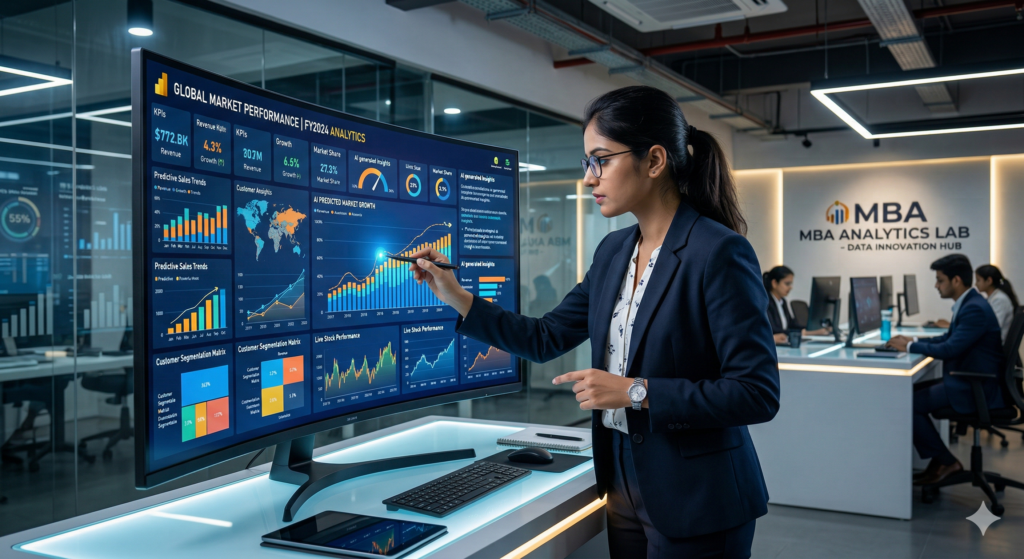
Data Visualisation Numbers without narrative rarely drive decisions. The curriculum dedicates serious attention to data visualisation principles — not just how to build a chart, but how to design a visual argument. Students work extensively with Power BI and Tableau, two of the most widely deployed business intelligence tools across Indian and global enterprises. By the time they graduate, they can build interactive dashboards that turn complex datasets into clear strategic recommendations.
Predictive Analytics Predictive analytics sits at the commercial heart of the programme. Students learn to build models that anticipate customer behaviour, market shifts, operational bottlenecks, and financial risks. Equally importantly, they learn to evaluate model accuracy, manage uncertainty, and communicate confidence levels to non-technical decision-makers — a skill that separates analysts from advisors.
AI Strategy A standout module in the UKS curriculum, AI Strategy moves beyond the technical into the organisational. How do you build a data culture in a legacy company? How do you evaluate the ROI of an AI initiative? What are the ethical implications of algorithmic decision-making? Students engage with these questions seriously, preparing them for senior roles where they will be shaping — not just executing — technology strategy.
Business Intelligence Tools: Power BI and Tableau Proficiency in Power BI and Tableau is now a baseline expectation in analytics-facing roles. The programme ensures students develop hands-on fluency in both platforms, understanding when to use each, how to connect them to live data sources, and how to design dashboards for different stakeholder audiences.
The UKS Difference: Management Thinking at the Core
Many analytics programmes teach tools. UKS Institute teaches judgement.
The PGDM framework means that data science skills are embedded within a full management education. Students study marketing management, financial analysis, operations, organisational behaviour, and strategic management alongside their analytics modules. This is deliberate. An analyst who understands how supply chains work will build better demand forecasting models. A data professional who understands consumer psychology will design better customer segmentation frameworks.
UKS Institute’s Mumbai location adds another dimension. Operating in India’s financial and commercial capital means students are consistently exposed to the industries — banking, fintech, media, retail, consulting — that are deploying analytics at scale. Guest lectures, industry interactions, and live project partners reflect the city’s commercial ecosystem.
Real-World Projects and Case Studies
The PGDM AI Business Analytics programme at UKS is structured around application, not abstraction. Students work on live datasets, solve real business problems, and present findings to industry panels.
Case studies draw from sectors including e-commerce logistics optimisation, retail customer lifetime value modelling, healthcare resource allocation, and financial fraud detection. These are not textbook exercises. They are structured to replicate the ambiguity and constraints students will face in actual roles — incomplete data, conflicting stakeholder priorities, tight timelines.
The capstone project requires students to identify a genuine business problem, design an analytical approach, build and validate a model, and present a full strategic recommendation. By graduation, every student has a portfolio of documented, real-world analytical work — something that immediately differentiates them in interviews.
Career Outcomes: Roles, Industries, and Why This Specialisation Commands Premium Salaries
Graduates of the business analytics MBA India pathway enter a job market with remarkable depth. Roles include Business Analyst, Data Analyst, Analytics Consultant, BI Developer, Product Analyst, and Strategy Analyst, with pathways into more senior positions such as Analytics Manager, Data Science Lead, and Chief Data Officer over the medium term.
Industries hiring actively include banking and financial services, management consulting, e-commerce, healthcare analytics, telecom, and technology firms. The AI MBA program Mumbai graduates from UKS are equipped for both corporate roles and analytics-led entrepreneurship.
The salary premium for analytics-specialised management graduates is well-documented. Entry-level analytics roles in India’s top companies offer packages that routinely exceed those in general management tracks, and the gap widens significantly at the mid-career level. The reason is structural: supply has not caught up with demand, and the combination of technical capability and management communication remains genuinely rare.
Is This Programme Right for You?
If you are a graduate with an interest in data, a curiosity about how technology is reshaping business, and an ambition to work at a strategic level rather than just an operational one — the PGDM in AI & Business Analytics at UKS Institute, Mumbai is designed specifically for you. You do not need a prior technical background. You need intellectual rigour, analytical curiosity, and the drive to develop a skill set that the economy genuinely needs.
The data-driven economy is not a future scenario. It is the present reality. The question is whether you are positioned to lead within it.
UKS Institute Mumbai is building professionals who are. Explore the programme at uks.bunts.edu.in.